|
|
Revista de Educación Mediática y TIC 2025, 14 (2). ISSN 2254-0095 |

DEVELOPMENT OF TRANSMEDIA COMPETENCES IN HIGH SCHOOL STUDENTS IN ECUADOR
DESARROLLO DE COMPETENCIAS TRANSMEDIA EN ESTUDIANTES DE BACHILLERATO EN ECUADOR
Marcos Ibarra-Núñez1*, Jaime Ullauri-Ullauri 2 & Hugo Abril-Piedra3
1https://orcid.org/0000-0003-1746-5317; Universidad Autónoma de Zacatecas(México); marco.ibarra@uaz.edu.mx
2https://orcid.org/0000-0003-0509-4299; Universidad Nacional de Educación (Ecuador); jaime.ullauri@unae.edu.ec
3https://orcid.org/0000-0003-1746-5317; Universidad Nacional de Educación (Ecuador); hugo.abril@unae.edu.ec
*Autor de correspondencia: Marcos Ibarra-Núñez marco.ibarra@uaz.edu.mx
Recibido: 20/11/2024 Aceptado: 03/03/2025 Publicado: 15/07/2025
Resumen: El objetivo de este artículo es presentar una síntesis de uno de los resultados, producto del proyecto de investigación denominado "Educación Transmedia; competencias transmedia y estrategias de aprendizaje informal de adolescentes", realizado por docentes de la Universidad Nacional de Educación (UNAE), el cual se desarrolló en las unidades educativas de la zona 6 de educación en Ecuador, donde se pudo determinar el desarrollo de competencias transmedia y los aprendizajes informales adquiridos por estudiantes de secundaria del sistema educativo ecuatoriano. Los mismo que se desarrollan con mayor recurrencia en estudiantes secundarios de colegios privados a diferencia de estudiantes de colegios fiscales, independientemente de su ubicación geográfica, sea esta urbano o rural.
Abstract: The objective of this article is to present a synthesis of one of the results, a product of the research project called "Transmedia Education; transmedia competences and informal learning strategies of adolescents ", carried out by teachers of the National University of Education (UNAE), which was developed in the educational units of zone 6 of education in Ecuador, where it was possible to determine the development of transmedia competences and the informal learning acquired by high school students of the Ecuadorian educational system. The same ones that are developed with greater recurrence in secondary students at private high schools unlike students at state high schools, regardless of their geographical location, whether urban or rural.
Résumé: Cet article a pour objectif de présenter une synthèse des résultats du projet de recherche « Éducation transmédia : compétences transmédias et stratégies d'apprentissage informel pour les adolescents », mené par des professeurs de l'Université nationale d'éducation (UNAE). Ce projet a été mené dans des unités éducatives de la zone éducative 6 en Équateur. Il a permis d'évaluer le développement des compétences transmédias et des apprentissages informels acquis par les élèves du secondaire dans le système éducatif équatorien. Ces compétences sont plus fréquemment développées chez les élèves du secondaire issus d'établissements privés que chez ceux du public, quelle que soit leur situation géographique, urbaine ou rurale.
Palabras Clave: Alfabetización mediática; aprendizaje invisible; alfabetización transmedia.
Key words: Media literacy; invisible learning; transmedia literacy.
Mots clés: Éducation aux médias; apprentissage invisible; éducation transmédia.
INTRODUCCIÓN
This article emerges from the results obtained from the development of the project "Transmedia Education: Transmedia Skills and Informal Adolescent Learning Strategies" carried out by a group of teachers from the National University of Education Ecuador (UNAE), the objectives were the follow ones:
1. Identify transmedia competencies and informal learning strategies developed by adolescents outside the school realm.
2. Design a series of teaching activities based on the competencies and strategies identified in Objective 1.
3. Develop a Teacher Kit – a digital product, open and available online – that includes: a) an interactive map of transmedia competencies and informal learning strategies (Goal 1), and b) Teaching activities to implement with students within the formal education system (Goal 2).
It was developed in the educational units of zone 6 in Ecuador, which belongs to Azuay, Cañar and Morona Santiago, these cities were selected according to demographic, location, urban or rural criteria, and their financing, public or private, with the use of data collection techniques and tools such as: interviews, workshops, questionnaires, newspapers, among others.
The result of the application of data collection techniques and tools should found the type of transmedia content consumed, media resources used in conflict resolution, the communication platforms used to share information and resources for self-learning.
Youth learning and informal spaces
Jenkins (2006) identified several core competencies that young people develop outside the classroom such as: playing, interpreting, appropriating, judging, transmedia navigation, web browsing and negotiating, although now the spectrum of digital and virtual media proliferates, it is not entirely true that young people really are on their way to the production of transmedia content, they remain consumers (Bird, 2011; Ofcom, 2014; Pereira, Pinto &vMoura, 2015).
Information and Communication
In the world every second new information arises and can be consulted in a matter of seconds, in this environment people must develop skills of the search and healing of information, these are acquired informal spaces, but the majority are learned in informal spaces, they are very different from those of two decades ago, where there was no accessibility to information and worse even at the speed that we have now.
Technological development has changed the way human beings interact with each other and with our environment, this situation has led to various conceptualizations being applied, assigning names that identify them as members of a digital era, from the term of digital natives, because they are born in this age, as well as the name of thumb, because of the importance of the thumbs of our hands when communicating, all this has been given by the amount of applications they have.
These different ways of living have changed; therefore, education must also change in order to make people more easily adaptable to the social environment in which they develop and they also should think about what the role of teachers and schools would be.
Information and Communication
Transmedia literacy focuses on the practices of adolescents and young people outside of formal education institutions, in previous research, Jenkins (2006), identified several core competencies for transmedia literacy, including:
· Play
· Interpret
· Appropriation
· Judge
· Transmedia Navigation
· Network navigation
It is important to note that, although the spectrum of digital and virtual media is now proliferating, it is not entirely true that young people are actually on their way to the production of transmedia content, they remain consumers (Bird, 2011; Ofcom, 2014; Pereira, S, Pinto, M, Moura, 2015). In this sense Gutierrez and Tyner (2012) give a considerable role to the influence of the media in the teaching process learning of apprentices, in our case high school students. From this perspective, the education system and curricula cannot be considered not to contemplate the development of competence for the use of new information and communication technologies.
These participatory literacy cultures are presented as suitable contexts for informal learning Jenkins (2006) and Gee (2004), these dynamic studies can participate from the transmedia skills that believes it is also built in the context of interaction with others. In this joint action between the students each has a predominant role that makes him feel expert and that dominate the device and the transmedia tools that he employs in the generation of a certain content (Jenkins, p. 9).
"They are systematically spread across many distribution channels to create a unified and coordinated entertainment experience. [...] each medium provides its own original contribution to the development of history" (Jenkins, 2006).
Part of the analysis in this document is focused on identifying the competencies to share and create transmedia resources that first-year high school students possess, this was made with the aim of leveraging the new profile of media consumers they have developed, which Scolari (2013); Scolari et al. (2018) and Taddeo & Tirocchi (2021). calls as "prosumer", whose characteristics focus on being an active consumer, who participates in these transmedia narratives, which produces extensions and circulates them on the networks" (p.249) and enhance these competencies for the generation of nodes and learning networks, which allow both students and teachers to have better learning outcomes inside and outside of the classroom, in this perspective:
Practices and skills can be more easily separated in the beginning than in practice. For example, if a child edits. a video and uploads it to YouTube, this represents a set of digital practices, but it also requires – and therefore provides evidence for – a set of digital skills. Surveys reveal that they are positively correlated – more practices build, more skills encourage practices (Van-Deursen; Helsper; Eynon, 2014).
In addition, as Scolari argues, transmedia literacy aims to return to the various skills and activities focused on the production, generation and socialization of content by young people (prosumers), who have informally developed to integrate into work in the classroom.
Information and Communication
Today, in a world where every second new information arises, which can be consulted in fraction of seconds after being published, where social opinion is guided by this unimaginable amount of information, testing skills, skills such as the search and discrimination of it, the skills that the new generations possess and acquire in a formal but above all informal way, are totally different from those of two decades ago, Sartori (2012) in his book "Homo-Videns" proposes the emergence of a new type of human being, which the Italian calls by this same name, Homo-videns, by the importance, the force that takes the image and the graphic in any social space and the implications that this entails.
Similarly, the French philosopher Michel Serres (2013) calls this new person in a more subtle and affectionate way, with the name of “Pulgarcita”, this is by the primordial and relevant role that, in this time, have taken their thumbs, as support to communicate, express themselves and interact with others and the environment in which they live. Taking up this idea proposed by Serres (2013), adolescents and young people today do not perceive the world in the same way, do not inhabit the same space, that is, they are not contingent on three-dimensional physical space, but rather expand their presence to a world virtual, where you don't see content by walls, on the contrary, they are free to travel and move through this cyberspace, giving you endless possibilities. This as a result of countless programs and digital devices (hardware and software), which can be accessed today.
Currently, technology permeates all areas of society to such an extent that things are becoming digitized and, from Chul Han's perspective, transformed into Non-Things as a result of this digitization. In this sense, things are losing value and importance, while Non-Things are gaining ground and regaining relevance due to the overwhelming production of information (Chul-Han, B., 2022).
In this context, permeated by a vast ocean of technological developments, which favor the creation, sharing and search of information, the way these thumbs and thumbs learn has changed, which is why the way we teach, likewise, it must be changed, in order to respond to these new challenges facing education, given the above, the teaching role is also not exempt from change, so it is essential to rethink what the role of teachers should be in this learning scenario.
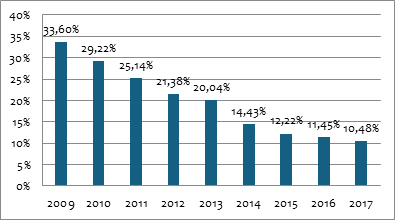
In this regard, the Ministry of Telecommunications (MINTEL, 2017) indicates that digital illiteracy, in the population aged 15 to 45, has declined substantially over the past eight years, from 33.60% in 2009 to 10.48% in 2017, which shows the importance of knowing the transmedia skills in adolescents. Another important factor is that 75.90% of people with a cell phone, in 2017, within the use that the activities they perform with this device are playing or playing music, activities that, as will be discussed later, they are of the major actions that students take more frequently to consume transmedia content.
Similarly, the population's growth in the use of the internet as an information consultation tool has been constant, reaching 40.63% of the population, a situation that confirms the relevance of knowing what skills linked to the use of technology develops adolescents today, with the aim of being able to design relevant strategies and instruments that allow them to return to these skills and enhance the process of teaching-learning in middle education.
Regarding this, the Ministry of Telecommunications (MINTEL, 2017) indicates that digital illiteracy in the population aged 15 to 45 has decreased substantially in the last eight years, from 33.60% in 2009 to 10.48% in 2017, as shown in the graph below, which demonstrates the importance of knowing the transmedia skills of adolescents.
Figure 1: Digital Illiteracy (15 to 49 years old) Source: INEC, Elaboration: MINTEL, 2017.
Another important fact is that 75.90% of people with a cellphone, in the year 2017, use it for activities such as playing games or listening to music, which are among the main actions that students frequently perform to consume transmedia content, as we will discuss later on.
Figure 2. Percentage of people who use the internet to obtain information Source: INEC, Elaboration: MINTEL, 2017.
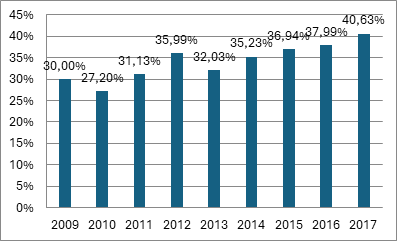
Likewise, the constant growth in the population's use of the internet as an instrument for obtaining information has also been observed, reaching 40.63% of the population. This confirms the relevance of understanding what technology-related skills teenagers are developing today, in order to design relevant strategies and tools that can enhance the teaching-learning process in middle education.
Teaching and institutional role in techno-pedagogical context
As we mentioned previously, the rise, development and increase in accessibility to technology has enabled new forms of interaction, perception, as well as learning. In the face of such a situation, the use of technology as a resource and/or teaching strategy, as well as transmedia resources and the search for innovation in the teaching-learning (PAE) process, is essential. In order to be faced with such a situation, teachers, as well as educational institutions, must propose innovative outings, which enable teachers to benefit from the transmedia skills that adolescents and young people develop on an informal level.
Undoubtedly, another fundamental element to consider in the quest to implement these processes of innovation, is Serendipity, as a nodal part of that process, comprising it, as Siemens (2010) mentions, as a function of experimentation, chance and error, which could not be conceived without this component. From this perspective, educational institutions are obliged to provide the resources and tools at their disposal, so teachers and teachers are motivated to propose innovative activities that promote and retake the skills students currently have to resume them and energize learning. Similarly, it is important that teachers have the necessary skills to incorporate into the technology in the EA, that is, that it has the ability to provide an appropriate model of use, since, without this, the incorporation of the technology will not have the impact Desired.
In this sense, the impact of innovation on the construction of a "new" school is critical. To this end, Serres (2013, p.52), mentions that "The classroom of other times has died, even if it is still seen, even if it is still being built, even if society still seeks to impose it again. In contrast, in the new classrooms, bodies are mobilized, circulated, gesticulated, called, challenged, gladly exchanged what they have found in their pockets", that is, information and knowledge available to their thumbs, content in digital media.
These innovative actions will respond to the construction of these new learning environments, offering future teachers the tools to adapt to different educational contexts, allowing to adjust their practice to the resources with which educational institutions, the incorporation of the new skills (transmedia), which students today have developed as a result of the omnipresence of technology and, from this, generate the best conditions to achieve these connections and nodes that allow the construction of knowledge, skills development as well as the acquisition of competences.
How is UNAE positioned in this context? The National University of Education is planted as an advanced Institution of Higher Education, based on a pedagogical model of great depth (UNAE, 2017), where Connectivism, from the premise that knowledge is created collectively, through the development of connections, networks and nodes among the educational community, regains great importance as the driving axis of the articulation between Innovation, pedagogy and educational technology as an enhancer of the PEA, which allow future teachers, through these built connections, the acquisition of strategies, knowledge generation and the development of the necessary skills, that allow them to face these new situations in the classroom
METHODOLOGY
The results presented in this article are the product of the research project Transmedia Education: Transmedia Competencies and informal learning strategies of adolescents, with the participation of Luis Cordero schools and Salesian Technician, which offer higher basic education and high school, from the cities of Azogues and Cuenca respectively, with a total of 65 students of third year of high school, in the range between 17 to 18 years old, in which 24 are women and 41 are male. Subsequently, the data collected using the NVivo 12 Pro ® qualitative analysis software was organized and systematized.
Various tools for information gathering, participating observation, questionnaires, participatory culture workshops and video games were used for the analysis, and finally in-depth interviews with relevant actors, who showed a high capacity in the use of digital tools, detected in the previous phases, which are in a number of four participants from each school in which the experience was developed. This is how we come to our goal of determining the basic competencies developed by students.
For the research, two educational institutions were selected unified general baccalaureate (BGU), "Luis Cordero" in the city of Azogues-Ecuador and the Technical Salesian" in the city of Cuenca-Ecuador. A BGU first course was selected from each educational unit, in addition to having to correspond to a tax center and/or trust either, respectively. The students who were part of each course participated in workshops, surveys and interviews. Through these instruments, important information was collected and systematized using The Nvivo 12 Pro® qualitative data analysis software.
At a general level, the analysis is carried out under a qualitative methodology, where different types of information collection tools were used covering participating observation, questionnaires, participatory culture workshops and video games, and finally in-depth interviews with four participants from each of the schools in which the experience was developed.
Similarly, qualitative, semi-structured and individual interviews were conducted in depth, based on the characteristics that Kallio, et al. (2016) mention, being more flexible, open and intimate, which allowed the interviewees would be comfortable with the questions and, for example, be more enriching for the project. This instrument is composed of general, structural and contrasting questions, with the aim of gathering fundamental information on the activities of problem and consumption of transmedia content that the interviewees develop. To this end, the interviews were conducted with actors, considered relevant, detected in previous phases of the research, which facilitated the understanding of aspects such as individual online learning strategies or access and socialization stories about participants' own experiences.
This is how they tried to understand aspects such as the individual online learning strategies of access to narratives about their own experiences in developing transmedia competence, that is why 4 participants were interviewed from each of the educational institutions, which could not be conceived without this component. From this perspective, educational institutions are obliged to provide the resources and tools at their disposal, so teachers and teachers are motivated to propose innovative activities that promote and retake the skills students currently have to resume them and energize learning. Similarly, it is important that teachers have the necessary skills to incorporate into the technology in the EA, that is, that it has the ability to provide an appropriate model of use, since, without this, the incorporation of the technology will not have the impact Desired.
In this sense, the impact of innovation on the construction of a "new" school is critical. To this end, Serres (2013, p.52), mentions that "The classroom of other times has died, even if it is still seen, even if it is still being built, even if society still seeks to impose it again. In contrast, in the new classrooms, bodies are mobilized, circulated, gesticulated, called, challenged, gladly exchanged what they have found in their pockets", that is, information and knowledge available to their thumbs, content in digital media.
These innovative actions will respond to the construction of these new learning environments, offering future teachers the tools to adapt to different educational contexts, allowing to adjust their practice to the resources with which educational institutions, the incorporation of the new skills (transmedia), which students today have developed as a result of the omnipresence of technology and, from this, generate the best conditions to achieve these connections and nodes that allow the construction of knowledge, skills development as well as the acquisition of competences.
How is UNAE positioned in this context? The National University of Education is planted as an advanced Institution of Higher Education, based on a pedagogical model of great depth (UNAE, 2017), where Connectivism, from the premise that knowledge is created collectively, through the development of connections, networks and nodes among the educational community, regains great importance as the driving axis of the articulation between Innovation, pedagogy and educational technology as an enhancer of the PEA, which allow future teachers, through these built connections, the acquisition of strategies, knowledge generation and the development of the necessary skills, that allow them to face these new situations in the classroom.
RESULTS
The results obtained in the research have allowed us to identify five basic competencies that students use for the creation and development of transmedia content, of which we have achieved precise knowledge. In this sense, the analysis also identifies informal strategies that students use as support for the creation and development of transmedia content. The analysis focuses solely on the transmedia competencies related to the creation and development of transmedia content that secondary school students in the educational institutions currently enrolled in possess.
Table 1. Examples of digital competencies taken from interview dialogues. Source: Own elaboration.
|
SPECIFIC COMPETENCIES |
DESCRIPTION AND EXAMPLES |
|
|
ABILITY TO SHARE TRANSMEDIA RESOURCES |
Use of social networks. Use of Bluetooth technology, NFC, and wireless data transmission |
Example 1 Roughly when I was 10 or 11 years old, my cousin showed me that Facebook is a place to communicate and meet more people and all that, so I found it interesting. And from that moment, since my cousin is 5 years older than me, she started helping me to use it, so my first photos were not posted by me because she helped me, as I didn't know how to.
Example 2 I usually share things like... let's say I'm browsing Facebook and come across any news and I share it so that everyone knows. For example, the other day I found a picture of a missing girl and shared it to help spread the word and find her. Also, for example, on Teacher's Day, I shared a photo and tagged my teachers whom I have on Facebook.
Example 3 Actually, what I sometimes focus on producing is more, let's say, on programs like Premiere, but it's sometimes more for work or some audiovisual idea that I need. From there, if it's for uploading to YouTube, yes, sometimes I use the Gmail page itself; but no, I'm not really a YouTuber.
|
|
ABILITY TO DEVELOP COLLABORATIVE WORK THROUGH THE USE OF DIVERSE DIGITAL PLATFORMS/COMMUNICATION |
Selection and use of platforms for collaborative work (Snapchat, Google Drive, BeFunky, YouTube, Memecreator, among others) |
Example 4 Yes, a collage, with a BeFunky application, and then we put photos here, for birthdays and such, it's easy to use.
Yes, for example, if I didn't do the homework, or a friend didn't do the homework and I want to send it to them without anyone knowing, I'll send it like that.
Example 6 Well, lately quite a few apps have been created to do this type of thing, meaning, they send an empty image and with those apps we can add texts, modify them, and add images.
Example 7 It's memecreator, I think. In a (unintelligible), [searches for the page in the browser] we even make them to tease each other. Here, it's this type of program here that allows us to... (pause) create or generate. [selects a link] This type here lets us upload an image and edit it, there are a lot of them, like this. They send us templates, and we add the texts we want and those things. |
|
ABILITY TO IDENTIFY AND CLASSIFY CONTENT FOR OFFLINE REUSE |
Search and storage of images, GIFs, video clips, and audio clips. |
Example 8 Mmmm, Photoshop, but it's also for works here. Sometimes they ask us to take a photo at school, recently they asked us to come up with a logo for the new swimming pool, so it was a contest and I participated and well, I also used Photoshop. Also, a contest that I organized that was about making robots in lines, so I also used Photoshop to make advertisements.
Example 9 And do you watch it online? JV: Yes, and since there are pages that let us download it, we have it and can watch it whenever we want.
Example 10 :Ah, do you have it on your phone? JQ: Yes. E: Show me. (JQ opens the SnapTube app on his phone) E: SnapTube? JQ: Yes. E: Is it an app for YouTube? JQ: Yes, for downloading music. E: For downloading music, SnapTube. And you keep it on your phone then? JQ: Yes.
|
|
ABILITY TO ANALYZE MULTIMEDIA CONTENT |
Analysis and reflection on various multimedia content in order to later comment and share on their social networks |
Example 11 You don't upload just anything. P: No, I think twice before uploading my photos, for example, I can also play games online. E: Okay, for example, when you watch a movie that you like, don't you search for products related to the movie? P: No, what I like to see the most is the mistakes that the movie has, for example. |
|
ABILITY TO CREATE TRANSMEDIA RESOURCES |
Design, creation, and sharing of multimedia and transmedia content for work or leisure purposes. |
Example 12 E:
How did you learn to create and share all of this? |
After the implementation of the developed instruments, various transmedia competencies developed by adolescents informally throughout their lives could be identified, FigureNo.1 shows what are compared to the various types of institutions, depending on their funding, where the research was conducted.
The transmedia competences found were:
•Capacity to share transmedia resources A10_C_COM_R-TM
•Ability to develop collaborative work using various pltodigital forms/communication A11_C_TC_PD
•Ability to identify and classify content for offline reuse A12_C_ID-CONT_R_OFFL
•Ability to scan media a13_C_ANA_CONT_TM
•Ability to create transmedia resources A14_C_CRE_R-TM
Figure 3. Transmediate competences. Source: Edutrans Research Project. Source: Own elaboration.
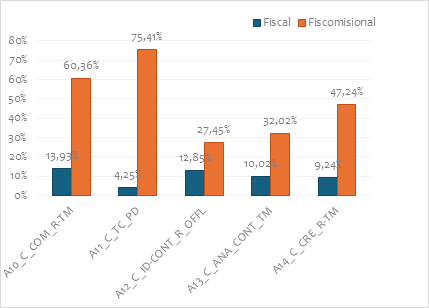
Developed competencies identified in the institutions in relation to the type of financing thereof.
Similarly, as can be seen in Figure 1, there is a distinct difference between the students who have developed these identified competencies, with the students of the fisommission institutions which have a greater progress, it is possible to infer that those who study in this type of school have greater access to technologies and for these circumstances, the growth of these detected skills is so mixed among the population of both types of schools.
Within each competition, sub-competences have been determined, as detailed below:
· For the A10_C_COM_R-TM competition, sub-competences such as the use of social networks, use of Bluetooth technology, NFC and wireless data transmission are proposed.
· In the case of the A11_C_TC_PD competition, the sub-competencies raised are the selection and use of platforms for collaborative work (SnapChat, Google Drive, Be Funky, YouTube, Meme creator, among others).
· The A12_C_ID-CONT_R_OFFL competition is sub-competitive to search and store images, gift, video clips and audio clips.
· In the A13_C_ANA_CONT_TM competition, sub-competences are analysis and reflection on various multimedia content for later commenting and sharing on your social networks.
· And in the last competition, A14_C_CRE_R-TM the defined sub-competences are the design, creation and socialization of multimedia and transmedia content for work or leisure purposes.
As Figure 3 shows, the transmedia competencies of the majority of the students interviewed are those linked to the development of collaborative work through the use of various digital platforms and the ability to share transmedia resources, which shows the active role of adolescents and young people in transmedia settings, a fact that could be used to enhance students' learning in educational institutions.
Likewise, according to the analysis of the content of interviews with students it can be inferred that the action in the creation and development of transmedia content is the activity that most percentage of students perform, distinguishing that schools fiscommissionals are above tax school students, and the same is presented independently, to the areas where schools are located, that is, regardless of whether they are urban or rural ones.
DISCUSSION AND CONCLUSIONS
The study conducted in this research can be concluded that young people develop learning, not only in school, where it was formerly the only place for learning, but there are other ways of learning that adolescents prefer and spend more time, taking these informal spaces, which schoolteachers should dare to take advantage of in order to develop more effective learning teaching processes.
It is important that teacher and should have competences in the use and integration of transmedia resources in the learning teaching process developed in the classroom, otherwise those competencies transmedia that adolescents today develop informally, it would be very difficult to pick up and take advantage, so if they do not have these skills, it is vital that the Ministry of Education focuses on the development of continuing training programmes that provide teachers with competencies.
In addition to the above, it is essential that schools take up teaching methodologies, which can respond to this new profile that adolescents and young people have developed today, avoiding continuously these old practices that prioritize the order and aestheticity of participants in the learning teaching process that occurs in the classroom.
REFERENCIAS
Álvarez, C. (2008). La etnografía como modelo de investigación en educación. Gazeta de Antropología, 24(1), 1–15. http://hdl.handle.net/10481/6998
Bird, S. E. (2011). Are we all producers now?: Convergence and media audience practices. Cultural Studies, 25(4–5), pp. 502–516. 10.1080/09502386.2011.600532.
Chul Han, B. (2022). No-Cosas (2nd ed.). Taurus
Gee, J. P. (2004). Lo que nos enseñan los videojuegos sobre el aprendizaje y el alfabetismo. Aljibe. Archidona (Málaga).
Gutiérrez, A., & Tyner, K. (2012). Media education, media literacy and digital competence. Comunicar, 19(38), 31–39. https://doi.org/10.3916/C38-2012-02-03
Helsper, E. J. (2014). Measuring Digital skills From Digital Skills to Tangible. https://doi.org/10.13140/2.1.2741.5044
Jenkins, H. (2006). Convergence Culture. New York: Paidós.
Kallio, H., Pietilä, A. M., Johnson, M., & Kangasniemi, M. (2016). Systematic methodological review: developing a framework for a qualitative semi‐structured interview guide. Journal of advanced nursing, 72(12), 2954-2965.
Ministerio de Telecomunicaciones del Ecuador. (2017). Observatorio TIC - Estadística. https://observatorioecuadordigital.mintel.gob.ec/
OFCOM. (2024). Children and Parents: Media Use and Attitudes Report. https://www.ofcom.org.uk/media-use-and-attitudes/media-habits-children/children-and-parents-media-use-and-attitudes-report-2024-interactive-data/
Pereira, S., Sinto, M., & Moura, P. (2015). Níveis de literacia mediática: Estudo exploratório com jovens do 12º ano. CECS - Centro de Estudos de Comunicação e Sociedade Universidade do Minho Braga - Portugal
Pink, S. & Morgan, J. (2013). Short-term ethnography: Intense routes to knowing. Symbolic Interaction, 36(3), 351–361. 10.1002/symb.66.
Sartori, G. (2012). Homo videns: la sociedad teledirigida. Madrid: Taurus.
Scolari, C. A. (2013). Cuando todos los medios cuentan. Cuando todos los medios cuentan. Barcelona Deusto.
Scolari, C. A., Masanet, M. J., Guerrero Pico, M. D. M., & Establés, M. J. (2018). Transmedia literacy in the new media ecology: Teens' transmedia skills and informal learning strategies. Profesional De La información, 27(4), 801–812. https://doi.org/10.3145/epi.2018.jul.09
Serres, M. (2013). Pulgarcita. Fondo de Cultura Económica.
SIEMENS, G. (2010). Conociendo el conocimiento. Nodos.
STAKE, R. (1999). Investigación con estudio de casos. Madrid: Morata.
Taddeo, G., & Tirocchi, S. (2021). Transmedia teens: the creative transmedia skills of Italian students. Information, Communication & Society, 24(2), 241-257. 10.1080/1369118X.2019.1645193.
UNIVERSIDAD NACIONAL DE EDUCACIÓN. (2017). Modelo Pedagógico. Azogues.
Stake, R. (1995). The Art of Case Study Research. Sage, Thousand Oaks, CA.
|
Contribución de los autores Los autores declaran que el diseño del trabajo, metodología, construcción de datos, análisis discusión y conclusión, así como, redacción, formato y revisión fueron realizados de forma equitativa e igual proporción. |
|
Financiación Este estudio fue financiado con recursos de la Universidad Nacional de Educación derivado del proyecto de investigación “Educación Transmedia: Competencias transmedia y estrategias informales de aprendizaje en los adolescentes”. |
|
Agradecimientos No aplica. |
|
Conflicto de intereses La autora declara no tener ningún conflicto de intereses. |
|
Declaración de uso de la IA para la redacción del manuscrito Los autores declaran no haber empleado la IA para la redacción total o parcial de este manuscrito, en ninguno de sus apartados |
Citación: Ibarra-Núñez, M., Ullauri-Ullauri, J., & Abril-Piedra, H (2025). Development of transmedia competences in high school students in Ecuador. EDMETIC, Revista de Educación Mediática y TIC, 14(2), art.7. https://doi.org/10.21071/edmetic.v14i2.17721