|
|
Revista de Educación Mediática y TIC 2026, 15(2). ISSN 2254-0059 |

ARTIFICIAL INTELLIGENCE IN CONTEMPORARY MOOCs FOR TEACHER TRAINING: DIDACTIC, ETHICAL, AND TECHNICAL ANALYSIS OF COURSES THROUGH AN EMERGENT CATEGORY SYSTEM
LA INTELIGENCIA ARTIFICIAL EN LOS MOOC CONTEMPORÁNEOS PARA LA FORMACIÓN DOCENTE: ANÁLISIS DIDÁCTICO, ÉTICO Y TÉCNICO DE LOS CURSOS A TRAVÉS DE UN SISTEMA DE CATEGORÍAS EMERGENTE
Emilio José Delgado-Algarra 1, Alejandro Carlos Campina-López 2, María del Mar Fernández-Martínez 3 & Cristina Prego de Óliver-López 4
1 https://orcid.org/0000-0002-2183-8465; Universidad de Huelva, Centro de Investigación COIDESO; emilio.delgado@ddcc.uhu.es
2 https://orcid.org/0000-0002-6221-347X; Universidad de Huelva, Centro de Investigación COIDESO; alejandro.campina@ddi.uhu.es
3 https://orcid.org/0000-0001-8465-6493; Universidad de Huelva; mar.fernandez@dstso.uhu.es
4 Universidad Rey Juan Carlos; cristina.prego@urjc.es
*Autor de correspondencia: --Emilio José Delgado Algarra, emilio.delgado@ddcc.uhu.es
Recibido: 20/07/2025 Aceptado: 10/10/2025 Publicado: 08/07/2026
Resumen: La expansión del uso de la Inteligencia Artificial (IA) se refleja en la oferta de cursos de formación del profesorado. Centrando la atención en los cursos masivos abiertos en línea (MOOC), esta investigación se desarrolla con el objetivo de comprender cómo se aborda el valor educativo de la inteligencia artificial en los MOOC contemporáneos dirigidos a la formación docente a través del diseño y aplicación de un sistema de categorías emergente que contempla dimensiones didáctico-formativas, éticas y técnicas. En cuanto a diseño de investigación, se aplicó una metodología cualitativa descriptivo-interpretativa basada en un análisis inductivo de contenidos. Durante el proceso se construye, ajusta, usa y valida un sistema de categorías emergente y con tres niveles progresivos de complejidad que nos permite establecer una hipótesis de progresión a tres niveles: nivel 1 - aproximación inicial, nivel 2 - aplicación funcional, y nivel 3 – integración transformadora. La muestra incluyó 25 MOOC seleccionados de la plataforma Coursera. En cuanto a los resultados, predominan niveles básicos o intermedios en torno a las competencias docentes, integración didáctica y uso técnico de la IA. Salvo excepciones, se observan limitaciones en cuanto profundidad crítica y reflexiva, siendo particularmente escasa la presencia de aspectos éticos avanzados como privacidad y la protección de datos o aspectos didáctico-formativos avanzados como la evaluación adaptativa. Los cursos con competencia funcional son los más desarrollados y equilibrados. Se concluye que, aunque se encuentran algunas propuestas formativas destacables en torno a dimensiones didáctico-formativa, ética y técnica de forma aislada, al analizar de forma conjunta el contenido de la mayoría de los cursos de la muestra, no se aborda el potencial transformador de la IA en educación. Por otro lado, el sistema de categorías emergente y la hipótesis de progresión constituyen un instrumento válido para futuros análisis sobre la integración educativa de la IA en la formación docente.
Abstract: The expansion of Artificial Intelligence (AI) usage is reflected in the increasing availability of teacher training courses. Focusing on Massive Open Online Courses (MOOCs), this research aims to understand how the educational value of AI is addressed in contemporary MOOCs designed for teacher education. This is achieved through the design and application of an emergent category system encompassing didactic-formative, ethical, and technical dimensions. A descriptive-interpretative qualitative methodology was applied, based on inductive content analysis. Throughout the process, an emergent category system with three progressive levels of complexity was constructed, refined, applied, and validated. This allowed the formulation of a three-level progression hypothesis: Level 1 – initial approach, Level 2 – functional application, and Level 3 – transformative integration. The sample consisted of 25 MOOCs selected from the Coursera platform. In terms of results, basic or intermediate levels predominated in relation to teaching competences, didactic integration, and technical use of AI. With few exceptions, there was limited critical and reflective depth. Particularly scarce were advanced ethical considerations such as data privacy and protection, as well as advanced didactic-formative aspects such as adaptive assessment. Courses exhibiting functional competence were the most developed and balanced. It is concluded that, although some notable training initiatives address didactic-formative, ethical, and technical dimensions in isolation, most of the courses analysed do not address the transformative potential of AI in education. On the other hand, the emergent category system and the proposed progression hypothesis constitute a valid tool for future analyses of AI's educational integration in teacher training.
Résumé: L’expansion de l’usage de l’intelligence artificielle (IA) se reflète dans l’offre croissante de cours de formation pour les enseignants. En se concentrant sur les cours en ligne ouverts et massifs (MOOC), cette recherche vise à comprendre comment la valeur éducative de l’IA est abordée dans les MOOC contemporains destinés à la formation des enseignants, à travers la conception et l’application d’un système de catégories émergent intégrant des dimensions didactico-formatives, éthiques et techniques. Une méthodologie qualitative descriptive et interprétative a été adoptée, reposant sur une analyse inductive de contenu. Au cours du processus, un système de catégories émergent comportant trois niveaux progressifs de complexité a été élaboré, ajusté, utilisé et validé. Cela a permis de formuler une hypothèse de progression à trois niveaux : niveau 1 – approche initiale, niveau 2 – application fonctionnelle, et niveau 3 – intégration transformatrice. L’échantillon se compose de 25 MOOC sélectionnés sur la plateforme Coursera. Les résultats montrent une prédominance de niveaux basiques ou intermédiaires concernant les compétences pédagogiques, l’intégration didactique et l’usage technique de l’IA. À quelques exceptions près, on observe des limites en termes de profondeur critique et réflexive, avec une présence particulièrement faible des aspects éthiques avancés tels que la protection de la vie privée et des données, ou des dimensions didactico-formatives avancées comme l’évaluation adaptative. Les cours présentant une compétence fonctionnelle sont les plus développés et équilibrés. En conclusion, bien que certaines initiatives de formation se distinguent par leur traitement isolé des dimensions didactico-formative, éthique et technique, l’analyse conjointe du contenu de la majorité des cours de l’échantillon révèle une absence de prise en compte du potentiel transformateur de l’IA en éducation. Le système de catégories émergent et l’hypothèse de progression offrent un outil pertinent pour de futures analyses sur l’intégration de l’IA dans la formation des enseignants.
Palabras Clave: Inteligencia Artificial; Formación docente; MOOC; Educación; Categorías emergentes
Key words: Artificial Intelligence; Teacher Training; MOOC; Education; Emergent Categories
Mots clés: Intelligence Artificielle; Formation des enseignants; MOOC; Éducation; Catégories émergentes
INTRODUCTION
The popularisation of artificial intelligence (AI) in recent years has profoundly transformed the social, economic, and cultural dynamics of contemporary societies. Generative AI tools such as ChatGPT, DALL·E, and Bard are opening up new domains that will affect the way people learn, interact, and collaborate with one another (Lim et al., 2022). In this regard, the expansion of AI is not foreign to education. Within this context, teachers’ responses range from fear and outright rejection to a kind of technological activism that treats technology use as an end in itself. A significant portion of the teaching profession fears not only that AI may displace or reduce their work, but also that it could affect creativity and the development of critical thinking in education (Alwaqdani, 2024; Chan & Tsi, 2024; Ghamrawi et al., 2024; Stavroulakis et al, 2025).
The development of AI requires a profound reflection on the changes it entails for teaching practice and the design of learning activities. In other words, the growing presence of AI in social and educational contexts is not merely a technological phenomenon, but also a deeply pedagogical, ethical, and political issue that is reshaping our ways of engaging with the world. AI goes beyond the automation of processes and demands new pedagogical knowledge to address the structural and profound transformations affecting the ways we teach, learn, and live together (Holmes et al., 2022; Miao et al., 2021). Moreover, changes are also required for the efficient use of AI as a resource, as users ultimately bear the responsibility of verifying and validating the information it provides.
Beyond its instrumental function, the socio-educational value of AI lies in its potential to create more personalised, inclusive, ethically guided, and pedagogically meaningful learning environments (Walter, 2024). While AI can undoubtedly enhance efficiency and productivity, reducing its value to such dimensions alone is limiting. Its responsible use must be rooted in a critical and humanistic perspective, aligned with the frameworks proposed by international bodies such as UNESCO (2021) and the European Parliament (2024). Active citizen participation in AI implementation is essential to avoid exclusion and to strengthen democracy (Robinson, 2020).
Therefore, more broadly speaking, AI acts as a mediating agent of digital culture and the way citizens interact with their reality (Dangol et al., 2024), redefining teaching competencies and the principles that underpin teaching and learning processes. However, the use of AI in education raises numerous questions for education professionals, which has led to its growing presence in training courses.
In the field of online training, Massive Open Online Courses (MOOCs) represent a privileged modality for observing how narratives and pedagogical approaches are constructed around AI. A recent study based on a representative sample of 292 MOOCs on AI identified three main profiles of AI-focused MOOCs (Delgado-Algarra et al., 2025, p. 11):
- AI MOOCs focused on AI coding is the most technical profile and it is linked to the creation of instructions for the computer to perform different tasks, including the values of humans who are involved in the coding and data collection used to train the algorithm.
- AI MOOCs focused on AI learning include AI’s learning processes and algorithm types, such as decision trees (Machine Learning) and neural networks (Deep Learning).
- AI MOOCs focused on the educational value of AI link to educational teaching and learning, inclusion, and ethical data use.
The findings of this study reveal that MOOCs focused on AI programming constitute the most prevalent profile within the current training offer, aligning with the framework proposed earlier by UNESCO (2021). However, courses oriented towards analysing the educational value of AI, although part of an emerging trend, remain significantly underrepresented in comparison with the other two profiles. While MOOCs related to AI offer an opportunity to enhance education and promote its democratisation, it is essential for the educational community to actively address the ethical and social considerations entailed by its implementation (Amato et al., 2023). This type of AI-focused MOOC aligns with studies such as González Fernández et al. (2025), who emphasize the importance of aligning the use of AI with EU and UNESCO frameworks, including transparency, traceability, human oversight, and data protection, and call for the institutionalization of ethical policies and audits within universities. It also converges with the research of Villegas-José and Delgado-García (2024), which highlights the need for the responsible use of AI and for addressing the ethical and social challenges of its application with students, including issues such as privacy and data protection.
This situation suggests that, although there is growing interest in promoting an ethical, inclusive, and pedagogically meaningful use of AI in educational contexts (Delgado-Algarra et al., 2025; Hazari, 2024), training specifically targeted at teacher education has yet to reach the level of development and provision found in programmes aimed at professionals from more technical sectors.
In the present study, we focus on MOOCs centred on the educational value of AI, from which a set of emergent categories has been derived based on both the available training offer and a selection of recent scientific literature concerning the educational potential of AI. This review has enabled the identification of key dimensions related to education and specific teaching methodologies, leading to the definition of subcategories, indicators, and descriptors that shape a category system — a second-order instrument that structures the analysis of MOOCs and allows us to assess the depth of AI-related MOOCs across three levels. This facilitates the construction of a progression hypothesis and enables us to determine the current positioning of these courses in relation to said hypothesis.
The emergent categories of MOOCs focused on the educational value of AI were as follows: the didactic-formative dimension, the ethical dimension, and the technical dimension.
Didactic-formative dimension of AI
When introducing AI into education, teachers can make the most of this technology to optimise the teaching-learning process. The didactic-formative dimension in MOOCs on Artificial Intelligence (AI) ranges from basic conceptual literacy to the critical and reflective integration of AI into teaching practice. "Teacher competence in AI" involves not only knowledge of fundamental concepts and the general functioning of AI, but also the ability to apply AI tools in educational practice and critically analyse their pedagogical and ethical implications—elements highlighted in reviews on teacher AI competence (Casal-Otero et al., 2023). In a recent study, Zhai (2024) explores how teachers progress from an initial stage of unfamiliarity or passive observation to an active and ethical integration of AI, recognising its pedagogical and ethical dimensions, thereby reinforcing this emerging subcategory.
Regarding teacher competence in AI, three levels may be established. Conceptual knowledge represents the foundation of technological literacy and refers to the theoretical and conceptual underpinnings of AI, linked to its educational potential (Vallejo Rodríguez et al., 2025). Functional competence entails moving from knowing to doing—applying AI in a practical and instrumental way within teaching, such as using writing assistants (González García, 2025, Hinojo-Lucena et al., 2019; Zhai, 2024). Critical competence represents a reflective and transformative use of AI, encompassing the educational, social, and cultural implications of dependency on such technologies (Angeli & Valanides, 2015; Selwyn, 2019; Roe & Perkins, 2024).
These three levels closely align with the AI Literacy Coding Framework and Bloom’s Taxonomy adapted for AI literacy (Ng et al., 2021), where learners are expected to progress from an initial stage of understanding AI to a second stage of using and applying it, and finally to a third stage of evaluating and creating with AI applications. Transversally to this last stage lies the level related to AI ethics. In relation to the didactic integration of AI, the levels move from anecdotal applications to disciplinary and ultimately interdisciplinary approaches, where AI is incorporated with clear pedagogical goals and in connection with other knowledge domains—consistent with curriculum design recommendations and meaningful integration of AI into education.
Regarding assessment with AI, it is worth noting that educational assessment is one of the areas in which AI can have a significant impact, automating processes to reduce teachers’ workload while providing immediate, meaningful, and adaptive feedback (González-Calatayud et al., 2021; Minn, 2022; Owan et al., 2023; Zhao, 2024). It also allows for personalised instruction and has the potential to assess complex cognitive skills (Minn, 2022; Zhao, 2024).
However, beyond concerns about bias, privacy, transparency, and data protection in AI-assisted assessment processes (Perkins et al., 2024; Zawacki-Richter et al., 2019), the introduction of AI in education has generated specific concerns among teachers—particularly regarding how to effectively integrate these technologies (Ng et al., 2023). Notably, there is a growing frustration and difficulty in evaluating and distinguishing between student-generated work and content produced by AI (Jose & Jose, 2024). This often leads to resistance and mistrust—stemming from a lack of knowledge and a lack of training on how to appropriately incorporate AI into teaching (Ng et al., 2023; Velander et al., 2023).
For this reason, AI education should prioritise process-oriented assessment over outcome-oriented assessment, which requires specific pedagogical knowledge on the part of educators (Kim et al., 2021). Therefore, there is a clear need for targeted teacher training, enabling AI to be integrated effectively into classrooms as a complementary tool that should never fully replace the teacher (Kim, 2024; Zawacki-Richter et al., 2019). Moreover, AI should be leveraged to enhance personalisation, adaptability, and efficiency in assessment processes (Chan & Tsi, 2024; Kim, 2024). Overall, the integration of AI in higher education and MOOCs is associated with improvements in personalisation, learning management, and assessment—but also presents challenges in terms of teacher training and the adaptation of traditional pedagogical models.
Ethical dimension of AI
The ethical dimension of AI in education is gaining increasing relevance due to the growing impact of intelligent systems on teaching and students’ learning experiences (Holmes et al., 2022; Nguyen et al., 2023). As highlighted by Miao et al. (2021) and Delgado-Algarra et al. (2024), several key ethical concerns should be taken into account: the need to establish and regularly update clear criteria for the ethical use and collection of student data; the difficulty in understanding or questioning how AI systems arrive at certain decisions; the ethical responsibilities that both private companies (as developers) and public institutions (such as schools and universities) must uphold; and the influence that students' emotional states and the inherent complexity of teaching and learning processes have on how AI-generated data should be interpreted and ethically applied in education.
Beyond general frameworks, the ethical approach promoted by UNESCO is set out in several key documents that have decisively shaped international perspectives on AI in education. These aim to ensure the responsible development of AI systems that respect human rights, promote equity, and enhance teaching and learning processes without dehumanising education. Among the most prominent documents are the Beijing Consensus on Artificial Intelligence and Education (UNESCO, 2019), AI and Education: Guidance for Policymakers (Miao et al., 2021), and the Recommendation on the Ethics of Artificial Intelligence (AHEG, 2020; UNESCO, 2021). These texts have been thoroughly analysed by Nguyen et al. (2023), who—through a systematic and comparative review of international regulatory frameworks—identify seven fundamental principles for a human-centred and ethically sound approach to AI in education: (1) governance and stewardship, (2) transparency and accountability, (3) sustainability and proportionality, (4) privacy, (5) safety and security, (6) inclusiveness, and (7) human-centredness.
These principles become even more significant when considering that many AI systems collect and process vast amounts of personal data, potentially compromising student privacy if not properly managed (Akgun & Greenhow, 2022; Klimova et al., 2022; Nguyen et al., 2023). Many of these systems operate as so-called “black boxes,” making it difficult for students to understand how their data is used and how decisions are made (Ivanov, 2023; Robinson, 2020; Yu & Guo, 2023). This lack of transparency reinforces the urgent need for ethical regulation to ensure fairness and clarity in AI-assisted educational systems (Palmeiro et al., 2025), as well as the need for a just, comprehensible, and human-centred application of AI in education.
Technical dimension of IA
Just as Shulman (1986) conceptualised Pedagogical Content Knowledge (PCK) and given that the importance of teachers’ pedagogical and ethical knowledge has already been addressed in the dimensions previously described, we now incorporate Technological Knowledge (TK) as the technical dimension. This dimension is essential for the effective integration of technology into teaching, aligning with the Technological Pedagogical Content Knowledge (TPACK) framework (Mishra & Koehler, 2006; Kim et al., 2021). It is considered crucial to specify the technical use of AI within the analysed educational environments, particularly in relation to the knowledge, design, development, and adaptation of AI-based tools and activities that support teaching and learning processes.
Although the integration of technology into education often lacks a strong foundation in educational and learning theories (Bower, 2019), positive educational outcomes do not occur simply by virtue of using the most advanced technologies (Castañeda & Selwyn, 2018). In this sense, when AI functions as a platform or tool to support learners in achieving their goals—whether as a direct mediator or as a complementary assistant in the design and development of objectives—educational practice must remain focused on learners’ needs, offering a multidimensional analysis that can respond to their specific demands (Xu & Ouyang, 2022).
Considering this, and within the context of this new era of digital educational transformation, teachers must possess appropriate digital competencies and be able to select suitable AI-powered tools that connect their subject knowledge with the facilitation of both instruction and classroom management. Moreover, educators are expected to make full use of various educational programming languages and be familiar with a wide range of applications that help students understand the principles, uses, and functions of AI so they can be applied to real-world problems (Kim et al., 2021).
From this perspective, advanced use of AI should not be limited to knowing or applying AI-based tools; it should also encompass the ability to create content tailored to students’ profiles, interests, and performance. This implies an adaptive design approach, aimed at enhancing the personalisation and relevance of the learning experience
OBJETIVES
The expansion of MOOCs aimed at teachers and focused on artificial intelligence (AI) raises, among other issues, the need to understand what types of competencies, didactic approaches, and ethical considerations are promoted in their design. On this basis, we formulate a central objective and a series of specific objectives that will guide this study.
Central objective
- To understand the educational value of artificial intelligence in contemporary MOOCs aimed at teachers through the design and application of an emergent category system encompassing didactic-formative, ethical, and technical dimensions.
Specific objectives
- To develop, apply, and validate an emergent category system that specifies the didactic-formative, ethical, and technical dimensions of AI.
- To examine the didactic-formative dimension of AI in the analysed MOOCs, considering levels of teacher competence, approaches to didactic integration, and types of assessment.
- To identify the ethical dimension of AI in the analysed MOOCs, particularly regarding data privacy, data protection, and the ethical implications of its use.
- To explore the technical dimension of AI use in the analysed MOOCs, focusing on aspects such as interactivity, personalisation, and content adaptability.
METHOD
This study adopts a qualitative, descriptive–interpretative methodology, focused on content analysis of MOOCs on artificial intelligence (AI) aimed at teachers, and specifically those related to the educational value of AI (Delgado-Algarra et al., 2025). An inductive approach was employed (Denzin & Lincoln, 2018), with the aim of identifying patterns, dimensions, and levels of AI integration for educational purposes, considering its didactic, ethical, and technological uses (with a focus on application).
The process followed a second-order analytical logic, based on an emergent categorisation derived from the corpus under analysis (Miles, Huberman & Saldaña, 2014), supported by findings from similar or related research and official and institutional sources presented in the theoretical framework. In other words, the emergent category system was constructed using an inductive approach aligned with constructivist Grounded Theory (Charmaz, 2014), in which the researcher builds analytical categories progressively from the data, in constant dialogue with the scientific literature and their own interpretative experience.
Although existing frameworks were used as points of reference, the system was adapted during the coding of the MOOCs, enabling a theory generation rooted in the educational data analysed. This required two well-defined phases: A first phase of analysis focused on refining the category system, and A second phase of analysis dedicated to applying the category system to the data, thereby addressing the remaining research objectives.
Sample
The sample consists of 25 MOOC selected from the Coursera platform, which is widely recognised for its global reach and institutional quality (Laurillard, 2016; Margaryan et al., 2015). The courses were intentionally preselected using the platform's filtering tools and based on thematic relevance criteria, including only those that addressed artificial intelligence from an educational and teacher training perspective. Courses that focused exclusively on programming or technical aspects of machine learning, without any connection to educational processes, were excluded from the analysis.
Data Collection and Analysis
The process of data collection and analysis was carried out in accordance with the PRISMA 2020 guidelines (Page et al., 2021), adapted to a qualitative content review of MOOCs on artificial intelligence (AI). The following steps were followed, based on its key items (see Figure 1):
1. Literature review and definition of objectives: This stage involved reviewing relevant literature and defining the study’s objectives, followed by the initial drafting of the emergent category system.
2. Identification of sources of information: MOOCs were selected through a manual and targeted search on the Coursera platform using its filtering options. The search was limited to the year 2025 and focused specifically on courses addressing AI from an educational perspective aimed at teacher training.
3. Inclusion and exclusion criteria: Included MOOCs were those designed for educators that incorporated content related to the educational value of AI (e.g. ethics, didactic integration, personalisation, assessment). Courses that focused exclusively on programming, machine learning, deep learning, or technical aspects without an explicit educational or teacher-training focus were excluded.
4. Selection process: Initially, 71 AI-related courses were identified under the “Social Sciences” category on Coursera. After a preliminary review of titles, learning objectives, and course descriptions, 25 courses were selected that met the inclusion criteria regarding the educational value of AI.
5. Data extraction and organisation: Information was manually extracted by the authors and organised according to: course title, learning objectives, modules and content, promoted competencies/skills, and access link. The latter was included to consult additional information where necessary, such as module indexes.
6. Analytical instrument, validation, and coding procedure: The analysis was based on an emergent category system structured around three dimensions: didactic-formative, ethical, and technical. Each dimension was subdivided into subcategories and indicators arranged into three levels of progression. This system was developed based on specialised literature (Holmes et al., 2022; Selwyn, 2019; Miao et al., 2021; Zawacki-Richter et al., 2019; Kim, 2024) and refined during the analysis. The analytical process was conducted in two stages: an initial phase aimed at adjusting the category system, and a second phase in which the system was applied to the selected sample.
Based on the indicators and descriptors defined in the category system, data were independently coded by two researchers using an Excel sheet that marked the level reached by each course for each indicator. Coding was conducted in a blind and parallel manner, followed by an inter-coder triangulation session (Patton, 2015) to resolve discrepancies and reach consensus. The inter-coder agreement rate was 94.7%, indicating a high level of consistency and supporting the reliability of the analytical instrument. This strategy contributed to the internal validation of the coding tool and ensured methodological rigour (Creswell & Poth, 2018).
7. Synthesis of results: The findings were organised in Excel based on the level each course achieved for the respective indicators in the category system. A summary table was created, and the results were qualitatively interpreted according to the three-level progression hypothesis, grouping the indicators into first-level (basic), second-level, and third-level (advanced and desirable) outcomes.
8. Documentation and transparency: Every stage of the search, selection, and analysis process was thoroughly documented to ensure methodological transparency and allow for replicability of the study.
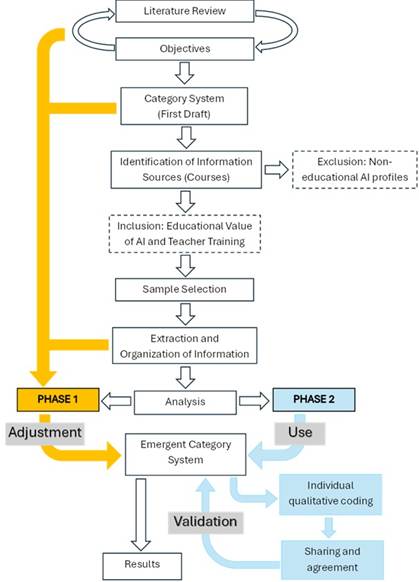 Figure
1. Research design. Source: Own elaboration.
Figure
1. Research design. Source: Own elaboration.
Following the description of the research design, sample composition, and the step-by-step process of data collection and analysis aligned with the PRISMA 2020 framework, we now move on to the results and discussion section.
RESULTS AND DISCUSSION
As shown in the heatmap (Table 1), regarding the level of AI competence promoted by the courses and according to the emergent category system, the majority of MOOCs are positioned at low or intermediate levels of progression, revealing a limited degree of critical engagement. These findings are consistent with those reported by Zhai (2024), who similarly analysed how teachers evolve from an initial position of unawareness or passive observation towards a more active and ethical integration of AI. This progression closely mirrors the structure of our own category system, with the third level—associated with critical depth—emerging as the most challenging to attain.
The results suggest a clear imbalance in most MOOCs between training focused on technical and functional aspects of AI, and that which promotes a critical and reflective approach. Nevertheless, a minority yet significant presence of courses addressing the level 3 indicator for critical competence was identified. Specifically, only 6 out of the 25 courses (24%) were found to promote a critical AI competence—enabling teachers to analyse, question, and make informed pedagogical decisions regarding the use of AI in education.
Table 1. Heatmap of development levels across emergent subcategories. Source: Own elaboration.
|
Subcategories |
Level 1 |
Level 2 |
Level 3 |
Not Applicable |
||||
|
Teacher competence in AI |
8 |
11 |
6 |
0 |
||||
|
Didactical integration of AI |
14 |
8 |
3 |
0 |
||||
|
Assesment with AI |
1 |
3 |
3 |
18 |
||||
|
Privacy and data protection with AI |
3 |
2 |
1 |
19 |
||||
|
Ethical implications of AI |
4 |
7 |
4 |
10 |
||||
|
Use of generative AI |
7 |
11 |
4 |
3 |
||||
|
0 – 1 (Very low) |
2 – 4 (Low) |
5 – 7 (Intermediate) |
8 – 11 (High) |
12 – 25 (Very high) |
||||
These findings suggest that the training offered by the analysed MOOCs stems from a purely instrumentalist view of AI-based technology to the detriment of a more reflective and context-aware approach. This highlights the need to improve the pedagogical design of such courses if they are to fulfil a transformative and educationally enriching function through AI-based education, and to reach higher levels of competence in line with Bloom’s Taxonomy for AI or the AI Literacy Coding Framework (Ng et al., 2021).
Regarding the didactic integration of AI, the results show that most of the MOOCs examined fall within the lower progression levels, particularly Level 1 within this category. This indicates a superficial or generic approach to the role of AI in teaching and learning processes, with limited connection to real pedagogical practices and scarce alignment with active methodologies or interdisciplinary approaches.
Only 3 out of the 25 MOOCs (12%) managed to incorporate AI in an interdisciplinary and contextually grounded way, based on the criteria defined in the category system. This finding is consistent with Cabero-Almenara et al. (2020), who presented evidence that digital courses for teachers on AI rarely adopt active or interdisciplinary methodological approaches. This suggests that most of these courses tend to present AI as an isolated or complementary topic, rather than as a transformative resource within the educational process. In light of this, there is a clear need to rethink the pedagogical design of MOOCs so that they support a meaningful, contextualised, and well-integrated use of AI within sound pedagogical frameworks (Kim et al., 2021).
Regarding assessment with AI, the results reveal a virtually residual presence of this dimension in the MOOCs examined. In this respect, the majority of courses (72%) do not address assessment as a formative component linked to the use of AI. Among the seven courses that do consider this aspect, only three (12%) reach the third level of progression, which involves a rigorous approach to AI-supported assessment, with a critical and learner-centred perspective.
This limited presence of training provision on the use of AI as an assessment tool—whether for learning monitoring, personalisation, or feedback—represents a missed opportunity for MOOCs to address common needs and concerns related to assessment in formal education contexts (Chan & Tsi, 2024; J. Kim, 2024). Moreover, it overlooks the chance to explore the potential of AI within educational frameworks supported and validated by the scientific literature in the field of didactics.
Regarding privacy and data protection, this dimension is very limited in presence across the analysed MOOCs. According to the results, 19 out of 25 courses (76%) do not address this issue at all, meaning that only six courses offer any kind of approach to the handling of personal data in AI-mediated educational contexts. Of those, only one course (4%) reaches Level 3, promoting a critical and contextualised understanding of the risks, regulations, and ethical principles related to digital privacy. This widespread omission is particularly concerning given the central importance of data protection in the responsible implementation of intelligent technologies. The lack of attention to this aspect reveals a training gap regarding digital rights, algorithmic transparency, and data sovereignty in teaching practice. Regarding the ethical implications of AI, we identified 4 courses (16%) at Level 1 (recognition-based), 7 courses (28%) at Level 2 (analytical), 4 courses (16%) at Level 3 (critical–emancipatory), and no presence in 10 courses (40%). This makes it the third most absent dimension among the six analysed in the teacher training courses. The ethical dimension of AI has been widely addressed in major international documents such as the Beijing Consensus on Artificial Intelligence and Education (UNESCO, 2019), AI and Education: Guidance for Policymakers (Miao et al., 2021), and the Recommendation on the Ethics of Artificial Intelligence (AHEG, 2020; UNESCO, 2021). In this regard, the findings of our study—and the warning sign represented by the deficiencies observed in training courses—are supported by the systematic review conducted by Nguyen et al. (2023), who identified a set of fundamental principles for ethical and human-centred AI in education, including privacy, safety and security, inclusiveness, and human-centredness. We consider that, as part of professional responsibility, these principles must not be ignored. Both the aforementioned principles and our position are aligned with the Ethical Technological Pedagogical Content Knowledge (ETPACK) model (Delgado-Algarra, 2021), a development of the original TPACK framework (Mishra & Koehler, 2006) that incorporates a transversal ethical dimension. This perspective is also supported by the work of Akgun & Greenhow (2022), Klimova et al. (2022), and Nguyen et al. (2023), who stress that many AI systems collect personal data in ways that may compromise student privacy, thereby requiring ethical and informed regulation to ensure a fair, transparent, and human-centred use of AI.
Regarding the use of AI, we found that 7 courses (28%) were at Level 1 (basic–exploratory), 11 courses (44%) at Level 2 (interactive–dynamic), and 4 courses (16%) at Level 3 (personalised–adaptive). No presence was recorded in 3 courses (12%). In this case, Level 2 predominates, characterised by interactive and multi-format learning experiences, such as AI-generated videos with branching pathways or differentiated learning routes. In this respect, research such as that by Pellas (2025) shows positive results regarding this use of AI, concluding that it leads to improvements in self-efficacy, academic performance, and retention. Similarly, Glicorea et al. (2023) conducted an analysis of 63 studies focused more specifically on the personalised–adaptive level of AI use as defined in our system. Their findings indicate improvements in student engagement and academic achievement; however, this level of AI use requires a degree of teacher professional development capable of addressing challenges such as data privacy (as discussed previously) and technical complexity.
The cross-frequency analysis between dimensions (Table 2) reveals several patterns. Conceptual competence (CL1) appears exclusively alongside generic integration (IL1) (6 instances). Functional competence (CL2) is present in courses with generic integration (IL1) (9), disciplinary integration (IL2) (4), and interdisciplinary integration (IL3) (2). In contrast, critical competence (CL3) is absent from all courses featuring generic integration (IL1) but emerges in those with disciplinary integration (IL2) (3) and interdisciplinary integration (IL3) (1). This is particularly relevant considering that 14 out of the 25 analysed courses adopt a generic approach to integration, and none of these exhibit critical AI competence. Therefore, a clear pattern of progression can be observed: as competence level increases (from CL1 to CL3), so does the complexity of integration (from IL1 to IL3). This leads us to conclude that courses adopting a more critical perspective tend to align with more advanced models of AI integration, such as disciplinary or interdisciplinary approaches.
Table 2. Contingency table. Source: Own elaboration.
|
|
CL 0 |
CL 1 |
CL 2 |
CL 3 |
IL 0 |
IL 1 |
IL 2 |
IL 3 |
AL0 |
AL 1 |
AL 2 |
Al 3 |
PL 0 |
PL 1 |
PL 2 |
PL 3 |
EL 0 |
EL 1 |
EL 2 |
EL 3 |
UL 0 |
UL 1 |
UL 2 |
UL 3 |
|
CL0 |
X |
|
|
|
|
|
|
|
|
|
|
|
|
|
|
|
|
|
|
|
|
|
|
|
|
CL1 |
X |
X |
|
|
|
|
|
|
|
|
|
|
|
|
|
|
|
|
|
|
|
|
|
|
|
CL2 |
X |
X |
X |
|
|
|
|
|
|
|
|
|
|
|
|
|
|
|
|
|
|
|
|
|
|
CL3 |
X |
X |
X |
X |
|
|
|
|
|
|
|
|
|
|
|
|
|
|
|
|
|
|
|
|
|
IL0 |
0 |
0 |
0 |
0 |
X |
|
|
|
|
|
|
|
|
|
|
|
|
|
|
|
|
|
|
|
|
IL1 |
0 |
6 |
9 |
0 |
X |
X |
|
|
|
|
|
|
|
|
|
|
|
|
|
|
|
|
|
|
|
IL2 |
0 |
0 |
4 |
3 |
X |
X |
X |
|
|
|
|
|
|
|
|
|
|
|
|
|
|
|
|
|
|
IL3 |
0 |
0 |
2 |
1 |
X |
X |
X |
X |
|
|
|
|
|
|
|
|
|
|
|
|
|
|
|
|
|
AL0 |
0 |
5 |
10 |
4 |
0 |
12 |
5 |
2 |
X |
|
|
|
|
|
|
|
|
|
|
|
|
|
|
|
|
AL1 |
0 |
0 |
1 |
0 |
0 |
0 |
0 |
1 |
X |
X |
|
|
|
|
|
|
|
|
|
|
|
|
|
|
|
AL2 |
0 |
0 |
3 |
0 |
0 |
1 |
2 |
0 |
X |
X |
X |
|
|
|
|
|
|
|
|
|
|
|
|
|
|
AL3 |
0 |
1 |
1 |
0 |
0 |
2 |
0 |
0 |
X |
X |
X |
X |
|
|
|
|
|
|
|
|
|
|
|
|
|
PL0 |
0 |
6 |
11 |
2 |
0 |
13 |
4 |
2 |
14 |
0 |
3 |
2 |
X |
|
|
|
|
|
|
|
|
|
|
|
|
PL1 |
0 |
0 |
2 |
1 |
0 |
1 |
4 |
2 |
2 |
0 |
3 |
2 |
X |
X |
|
|
|
|
|
|
|
|
|
|
|
PL2 |
0 |
0 |
2 |
0 |
0 |
1 |
1 |
1 |
2 |
1 |
0 |
0 |
X |
X |
X |
|
|
|
|
|
|
|
|
|
|
PL3 |
0 |
0 |
0 |
1 |
0 |
0 |
1 |
0 |
1 |
0 |
0 |
0 |
X |
X |
X |
X |
|
|
|
|
|
|
|
|
|
EL0 |
0 |
2 |
6 |
2 |
0 |
6 |
2 |
2 |
6 |
1 |
1 |
0 |
9 |
0 |
0 |
1 |
X |
|
|
|
|
|
|
|
|
EL1 |
0 |
0 |
4 |
0 |
0 |
2 |
1 |
1 |
2 |
1 |
1 |
0 |
2 |
2 |
0 |
0 |
X |
X |
|
|
|
|
|
|
|
EL2 |
0 |
1 |
4 |
2 |
0 |
3 |
4 |
0 |
7 |
0 |
0 |
0 |
5 |
1 |
1 |
0 |
X |
X |
X |
|
|
|
|
|
|
EL3 |
0 |
3 |
1 |
0 |
0 |
4 |
0 |
0 |
4 |
0 |
0 |
0 |
3 |
0 |
1 |
0 |
X |
X |
X |
X |
|
|
|
|
|
UL0 |
0 |
0 |
1 |
2 |
0 |
1 |
2 |
0 |
3 |
0 |
0 |
0 |
2 |
1 |
0 |
0 |
0 |
0 |
3 |
0 |
X |
|
|
|
|
UL1 |
0 |
3 |
4 |
0 |
0 |
1 |
2 |
0 |
7 |
0 |
0 |
0 |
6 |
1 |
0 |
0 |
2 |
0 |
3 |
0 |
X |
X |
|
|
|
UL2 |
0 |
2 |
8 |
1 |
0 |
6 |
1 |
0 |
8 |
0 |
0 |
0 |
8 |
1 |
0 |
0 |
5 |
1 |
3 |
1 |
X |
X |
X |
|
|
UL3 |
0 |
1 |
2 |
1 |
0 |
6 |
2 |
3 |
1 |
1 |
2 |
0 |
3 |
1 |
2 |
0 |
3 |
2 |
1 |
3 |
X |
X |
X |
X |
Courses with functional competence (CL2) are the most developed and balanced overall, appearing in a range of courses that demonstrate variety in integration, assessment, ethical treatment, and AI use. In contrast, courses with critical competence (CL3) are limited in number, and do not always align with higher levels of development in relation to assessment, data privacy, or AI usage. The privacy dimension (PL) is generally neglected, appearing only marginally in both basic and advanced courses across other subcategories. There also appears to be a disconnect between the ethical treatment of AI and other dimensions examined in the study.
To explore potential associations between the different subcategories of the emergent category system, Chi-square tests of independence were carried out for each pair of variables. These were complemented by the calculation of Cramér’s V as a measure of effect size (see Table 3). The Chi-square value is considered statistically significant when p < 0.05, and the magnitude of association, according to Cohen (1988), can be interpreted as small (0.10–0.29), moderate (0.30–0.49), and large (≥ 0.50).
Table 3. Chi-square test and Cramér's V analysis. Source: Own elaboration.
|
Variable 1 |
Variable 2 |
Chi-square |
gl |
p |
Cramer’ V |
|
Competence |
Integration |
10.151 |
4 |
0.038 |
0.451 |
|
Competence |
Assessment |
4.101 |
6 |
0.663 |
0.286 |
|
Competence |
Privacy |
8.713 |
6 |
0.19 |
0.417 |
|
Competence |
Ethics |
9.601 |
6 |
0.142 |
0.438 |
|
Competence |
Use |
9.107 |
6 |
0.168 |
0.427 |
|
Integration |
Assessment |
11.069 |
6 |
0.086 |
0.471 |
|
Integration |
Privacy |
5.301 |
6 |
0.506 |
0.326 |
|
Integration |
Ethics |
7.378 |
6 |
0.287 |
0.384 |
|
Integration |
Use |
8.209 |
6 |
0.223 |
0.405 |
|
Assessment |
Privacy |
9.187 |
9 |
0.42 |
0.35 |
|
Assessment |
Ethics |
12.193 |
9 |
0.203 |
0.403 |
|
Assessment |
Use |
16.029 |
9 |
0.066 |
0.462 |
|
Privacy |
Ethics |
11.568 |
9 |
0.239 |
0.393 |
|
Privacy |
Use |
9.659 |
9 |
0.379 |
0.359 |
|
Ethics |
Use |
14.101 |
9 |
0.119 |
0.434 |
When analysing the data, a moderate to moderately high association was found in most cases, indicating relevant relationships. However, these values were not always accompanied by statistically significant evidence, likely due to the limited sample size. Among the various combinations analysed, the most notable is the statistically significant and moderately high association between the subcategories of competence and integration (V = 0.451, p = .038). Other combinations that also presented noteworthy Cramér’s V values, despite lacking statistical significance, include:
- Assessment and use: χ²(9) = 16.029, p = .066, V = .462 [moderately high]
- Integration and assessment: χ²(6) = 11.069, p = .086, V = .471 [moderately high]
- Competence and ethics: χ²(6) = 9.601, p = .142, V = .438 [moderate]
- Competence and use: χ²(6) = 9.107, p = .168, V = .427 [moderate]
These results highlight associations that were identifiable thanks to the category system designed and implemented in this study, reinforcing the validity of the instrument. The statistical significance—or lack thereof—points to the need for further research with larger sample sizes to confirm these associations.
In any case, we align with Zhai (2024) in recognising the importance of ongoing teacher training and critical awareness regarding the use of AI in educational practice. Despite the areas for improvement observed in the analysis of the courses, we value the efforts made to provide teacher training through MOOC and also agree with the aforementioned author in stressing the importance of institutional support for such initiatives.
Category System and Progression Hypothesis
The second-order analytical instrument developed for this study was designed to address the need to understand the integration of artificial intelligence into teacher training from a critical, pedagogical, and situated perspective. This instrument was applied to the content analysis of MOOCs on AI. The emergent category system guided the content analysis of the AI-focused MOOCs in the sample. It is structured around three main dimensions: the didactic–formative dimension (Table 4), the ethical dimension (Table 5), and the technical dimension (Table 6). The didactic–formative dimension examines teachers’ AI competence, pedagogical integration approaches, and the use of AI in educational assessment; the ethical dimension considers privacy, data protection, and critical reflection on ethical dilemmas related to the use of AI in educational contexts; and the technical dimension evaluates the degree of interactivity, personalisation, and adaptability in the use of generative AI tools.
Table 4. Emergent Category System: Didactic-formative dimension. Source: Own elaboration.
|
Category |
Subcategory |
Indicator |
Descriptor |
Lev. |
|
Didactic-formative dimension |
Teacher competence in AI |
Conceptual knowledge |
Knowledge of basic AI concepts and general functioning. Examples: definitions, history, key concepts such as algorithm, machine learning, etc. Initial literacy. |
1 |
|
Functional competence |
Understanding of AI tools in educational practice. Examples: Integration of tools such as ChatGPT, DALL·E, AI-based assessment systems, etc. Instrumental and goal-oriented use. |
2 |
||
|
Critical use competence |
Knowledge of AI use with critical analysis, reflective pedagogical design, and meaningful, sustainable incorporation. Examples: critical reflection activities, classroom impact discussion, etc. Progressive and responsible implementation. |
3 |
||
|
Didactical integration of AI |
Generic integration |
AI is introduced or used in a general way, without explicit link to disciplinary content or clear pedagogical objectives. Use is transversal or complementary without clear contextualisation. |
1 |
|
|
Disciplinary integration |
AI is used with explicit pedagogical aims, within a specific discipline. Use is Oriented to reinforce subject-specific knowledge or competencies. |
2 |
||
|
Interdisciplinary integration |
AI is employed for well-defined pedagogical purposes, articulating knowledge and methodologies across multiple disciplines. Promotes solving complex problems through interdisciplinary convergence. |
3 |
||
|
Assessment with AI |
Basic automated feedback |
AI automatically generates fixed comments or closed grading. Same feedback for all. |
1 |
|
|
Assisted assessment |
AI assists teachers in feedback without changing students’ learning paths. Same content, different feedback. |
2 |
||
|
Adaptive assessment |
AI adapts assessment in real-time to students' performance. Personalised learning path based on responses. |
3 |
Table 5. Emergent Category System: Ethical dimension. Source: Own elaboration.
|
Category |
Subcategory |
Indicator |
Descriptor |
Lev. |
|
Ethical dimension |
Privacy and data protection with AI |
Awareness of student privacy |
Teacher awareness of data protection risks. |
1 |
|
Implementation of basic security measures |
Teacher implementation of settings to protect student data. |
2 |
||
|
Ethical design and implementation of secure environments |
Teacher leadership in the design and implementation of respectful and secure digital environments. |
3 |
||
|
Ethical implications of AI |
Recognition of ethical dilemmas |
Teacher identification of common ethical dilemmas in the use of AI, in accordance with principles and recommendations on AI ethics in education. |
1 |
|
|
Critical analysis of ethical dilemmas |
Teacher argumentation of ethical implications and consequences, in line with principles and recommendations on AI ethics in education. |
2 |
||
|
Critical–emancipatory development of ethical frameworks |
Teacher development and application of their own ethical frameworks for educational practice, aligned with principles and recommendations on AI ethics in education. |
3 |
Table 6. Emergent Category System: Technical dimension. Source: Own elaboration.
|
Category |
Subcategory |
Indicator |
Descriptor |
Lev. |
|
Technical dimension |
Use of generative AI |
Exploratory/basic use |
Initial, exploratory, and general use of AI to create simple, non-interactive content. Examples: generating texts, images, or activities not aligned with students’ needs. |
1 |
|
Interactive and dynamic use |
Use of AI to design interactive or multi-format learning experiences. Examples: content that enables interaction, such as dynamic quizzes, simulations, AI-generated videos with branching paths, etc |
2 |
||
|
Personalised and adaptive use |
Advanced use of AI to create content adapted to students’ profiles, interests, or performance, involving adaptive design. Examples: resources or content that vary based on the learner’s history or responses. |
3 |
Each subcategory includes operational indicators and associated descriptors, structured across three levels of progression, enabling the evaluation of the depth, complexity, and pedagogical orientation of the analysed courses. This progressive approach is inspired by international frameworks such as DigCompEdu (Redecker, 2017), AI and Education: Guidance for Policymakers (UNESCO, 2021), and by research on the critical integration of technologies in education (Angeli & Valanides, 2015; Holmes et al., 2022; Casal-Otero et al., 2023, among others). The three-level structure, based on clearly defined indicators and descriptors within each subcategory, allows for the formulation of a progression hypothesis, which is presented below:
Level 1: Initial approach – Fragmented and generic use of AI
MOOCs at this level offer a basic and introductory proposal. They focus on conceptual content about AI and on the generic, poorly integrated use of AI tools. AI is presented as an external topic, with no clear pedagogical connection or significant ethical or technological depth. Key features of Level 1 in relation to the emergent categories:
- Competence: Initial literacy and conceptual understanding of AI.
- Integration: Generic use with no specific didactic objectives.
- Assessment: Basic automated feedback (identical for all learners).
- Ethics: General awareness of privacy and recognition of ethical dilemmas.
- Use: Basic and exploratory use of generative AI to create simple content.
Level 2: Functional application – Disciplinary pedagogical integration with ethical support for AI
At this level, MOOCs promote the functional application of AI in educational practice. Specific tools are integrated into teaching and assessment tasks from a disciplinary perspective, with greater didactic coherence. Ethical aspects are addressed from a practical standpoint, although still largely dependent on the educator. The technology is used in more interactive ways. Key features of Level 2 in relation to the emergent categories:
- Competence: Functional didactic application; instrumental and goal-oriented use.
- Integration: Disciplinary integration with explicit pedagogical aims.
- Assessment: Assisted assessment (same learning path, different feedback).
- Ethics: Implementation of basic security measures and critical analysis of ethical dilemmas.
- Use: Interactive, multi-format use of generative AI.
Level 3: Transformative integration – Interdisciplinary, adaptive and critically emancipatory approach to AI
MOOCs at this level integrate AI in a transversal, critical, and sustainable manner. They promote deep reflection on AI usage, featuring adaptive strategies and interdisciplinary proposals. The ethical dimension is proactive, and the technology is tailored to student profiles. Key features of Level 3 in relation to the emergent categories:
- Competence: Critical and transformative integration; progressive, responsible, and context-aware use.
- Integration: Interdisciplinary approach with explicit pedagogical aims.
- Assessment: Adaptive assessment with real-time personalisation.
- Ethics: Implementation of secure environments and development of personal ethical frameworks.
- Use: Creation of personalised and adaptive content using generative AI.
CONCLUSIONS
The integration of the various development and triangulation processes enabled the refinement and application of an emergent, tailor-made category system. This system was independently used by different researchers to categorise the information from the selected courses. During the triangulation of the categorisation results, the inter-coder agreement reached 94.7%, indicating a high level of consistency among researchers and supporting the reliability of the categorisation instrument employed. All subcategories were structured into three levels (indicators and descriptors), which allowed for the formulation of a three-level progression hypothesis: Level 1 – Initial Approach, corresponding to a fragmented and generic use of AI; Level 2 – Functional Application, referring to disciplinary pedagogical integration with ethical support for AI; and Level 3 – Transformative Integration, characterised by an interdisciplinary, adaptive, and critically emancipatory use of AI.
Regarding the content analysis of AI in the selected MOOCs, basic or intermediate levels predominated across teacher competencies, didactic integration, and technical use of AI. With a few exceptions, limitations were observed in the critical and reflective depth of the analysed courses, with particularly scarce attention to advanced ethical aspects such as privacy and data protection. This widespread omission is especially concerning, given the central importance of data protection in the responsible implementation of intelligent technologies. The findings point to a training deficit related to digital rights, algorithmic transparency, and data sovereignty in teaching practice. Further limitations were found concerning advanced didactic elements, such as adaptive assessment. Courses promoting functional competence emerged as the most developed and cross-cutting across various dimensions and progression levels. While some noteworthy training proposals were identified in individual dimensions (didactic-formative, ethical, or technical), the majority of courses did not comprehensively address the transformative potential of AI in education across all dimensions.
This article provides an overview of how AI is approached in teacher training MOOCs, which may guide the design of future courses. It also presents an emergent category system and progression hypothesis that may serve as a valid instrument for future analyses of AI integration in teacher education, as well as for evaluating the pedagogical design of forthcoming training initiatives. In general terms, the findings of this study contribute to the understanding of how AI is integrated into teacher training MOOCs, revealing both progress and persistent gaps. The emergent category system is a robust analytical framework capable of identifying not only the prevailing instrumental orientation of most courses but also the limited presence of transformative pedagogical and ethical approaches. These results highlight the need for comprehensive teacher training that goes beyond the functional use of AI to embrace its ethical, critical and creative dimensions. According to this situation, teacher education programmes on MOOCs about AI could better prepare future educators to engage with AI promoting its responsible use and socio-educational inclusion.
Although the number of MOOCs selected from the Coursera platform was properly for the purposes of this study, a larger sample might have enhanced the statistical significance of certain dimensional relationships. In general, regarding limitations, it should be noted that the sample size reflects the limited availability of MOOCs specifically targeted at teacher training in AI at the time of selection, with a significantly higher number of courses focusing on technical aspects or topics unrelated to teacher education. Future research should expand the scope to include MOOCs from other platforms and languages, allowing for comparative analyses and a more global understanding of AI’s educational value in teacher training.
REFERENCES
AHEG. (2020). Ad Hoc Expert Group (AHEG) for the Preparation of a Draft text of a Recommendation the Ethics of Artificial Intelligence. https://unesdoc.unesco.org/ark:/48223/pf0000373434
Akgun, S., & Greenhow, C. (2022). Artificial intelligence in education: Addressing ethical challenges in K-12 settings. AI and Ethics, 2(3), 431-440. https://doi.org/10.1007/s43681-021-00096-7
Alwaqdani, M. (2024). Investigating teachers’ perceptions of artificial intelligence tools in education: Potential and difficulties. Education and Information Technologies, 30(3), 2737-2755. https://doi.org/10.1007/s10639-024-12903-9
Amato, F., Galli, A., Gravina, M., Marassi, L., Marrone, S., & Sansone, C. (2023). AI-Powered Learning: Personalizing Education for each Student. Proceedings of the Italia Intelligenza Artificiale - Thematic Workshops, 3486, 532-537. https://ceur-ws.org/Vol-3486/138.pdf
Angeli, C., & Valanides, N. (2015). Technological pedagogical content knowledge: Exploring, developing, and assessing TPCK. Springer. https://doi.org/10.1007/978-1-4899-8080-9
Bower, M. (2019). Technology-mediated learning theory. British Journal of Educational Technology, 50(3), 1035-1048. https://doi.org/10.1111/bjet.12771
Cabero‑Almenara, J., Barroso‑Osuna, J., Rodríguez, A. P., & Llorente‑Cejudo, C. (2020). Marcos de competencias digitales para docentes universitarios: su evaluación a través del coeficiente competencia experta. Revista Electrónica Interuniversitaria de Formación del Profesorado, 23(3), 17–34. https://doi.org/10.6018/REIFOP.414501
Casal‑Otero, L., Catala, A., Fernández‑Morante, C., Taboada, M., Cebreiro, B., & Barro, S. (2023). AI literacy in K‑12: A systematic literature review. International Journal of STEM Education, 10(1), Article 29. https://doi.org/10.1186/s40594-023-00418-7
Castañeda, L., & Selwyn, N. (2018). More than tools? Making sense of the ongoing digitizations of higher education. International Journal of Educational Technology in Higher Education, 15(1), 22. https://doi.org/10.1186/s41239-018-0109-y
Chan, C. K. Y., & Tsi, L. H. Y. (2024). Will generative AI replace teachers in higher education? A study of teacher and student perceptions. Studies in Educational Evaluation, 83, 101395. https://doi.org/10.1016/j.stueduc.2024.101395
Charmaz, K. (2014). Constructing grounded theory (2nd ed.). SAGE.
Creswell, J. W., & Poth, C. N. (2018). Qualitative Inquiry and Research Design: Choosing Among Five Approaches (4th ed.). SAGE.
Cohen, J. (1988). Statistical Power Analysis for the Behavioral Sciences (2nd ed.). Lawrence Erlbaum. https://doi.org/10.4324/9780203771587
Dangol, A. Newman, M., Wolfe, R., Lee, J. H., Kientz, J. A., Yip, J., & Pitt, C. (2024). Mediating Culture: Cultivating Socio-cultural Understanding of AI in Children through Participatory Design. Proceedings of the 2024 ACM Designing Interactive Systems Conference, 1805-1822. https://doi.org/10.1145/3643834.3661515
Delgado-Algarra, E. J. (2021). Ciencias Sociales y competencia digital: Hacia el uso igualitario de las tecnologías desde la educación formal. II International Seminar Education and LKT: Digital Competence, Gender Digital Gap and Virtuality in Initial Teacher Training, 10-11 de diciembre de 2021, Universidad de Alicante. https://vertice.cpd.ua.es/col/19082
Delgado-Algarra, E. J., Bernal-Bravo, C., Morales, B. & López-Meneses, E. (2024). Pedagogical and Technical Analysis of Massive Open Online Courses on Artificial Intelligence. Applied Sciences, 14(3), 1-18. https://doi.org/10.3390/app14031051
Delgado-Algarra, E. J., Vela-Romero, J. A., Ilardia, I. M. P., & Blázquez, M. M. P. (2025). Artificial Intelligence in MOOCs: Study of profiles and their socio-educational potential. IJERI: International Journal of Educational Research and Innovation, 23, Article 23. https://doi.org/10.46661/ijeri.11110
Ghamrawi, N., Shal, T., & Ghamrawi, N. A. R. (2024). Exploring the impact of AI on teacher leadership: Regressing or expanding? Education and Information Technologies, 29(7), 8415-8433. https://doi.org/10.1007/s10639-023-12174-w
Gligorea, I., Cioca, M., Oancea, R., Gorski, A.-T., Gorski, H., & Tudorache, P. (2023). Adaptive Learning Using Artificial Intelligence in e‑Learning: A Literature Review. Education Sciences, 13(12), 1216. https://doi.org/10.3390/educsci13121216
González-Calatayud, V., Prendes-Espinosa, P., & Roig-Vila, R. (2021). Artificial Intelligence for Student Assessment: A Systematic Review. Applied Sciences, 11(12), Article 12. https://doi.org/10.3390/app11125467
González Fernández, M. O., Romero López, M. A., Sgreccia, N., & Latorre Medina, M. J. (2025). Marcos normativos para una IA ética y confiable en la educación superior: estado de la cuestión. RIED-Revista Iberoamericana de Educación a Distancia, 28(2), 181-208. https://doi.org/10.5944/ried.28.2.43511
González García, P., Villarrubia Zúñiga, M. S., & Ortiz Jiménez, M. (2025). Artificial intelligence chatbots in language learning for disadvantaged populations (migrants and aboriginal). State of the art and challenge. EDMETIC, 14(2), art.5. https://doi.org/10.21071/edmetic.v14i2.17263
Hazari, S. (2024). Justification and Roadmap for Artificial Intelligence (AI) Literacy Courses in Higher Education. Journal of Educational Research and Practice, 14(1). https://doi.org/10.5590/JERAP.2024.14.1.07
Hinojo‑Lucena, F.‑J., Aznar‑Díaz, I., Cáceres‑Reche, M.‑P., & Romero‑Rodríguez, J.‑M. (2019). Artificial Intelligence in Higher Education: A bibliometric study on its impact in the scientific literature. Education Sciences, 9(1). https://doi.org/10.3390/educsci9010051
Holmes, W., Porayska-Pomsta, K., Holstein, K., Sutherland, E., Baker, T., Shum, S. B., Santos, O. C., Rodrigo, M. T., Cukurova, M., Bittencourt, I. I., & Koedinger, K. R. (2022). Ethics of AI in Education: Towards a Community-Wide Framework. International Journal of Artificial Intelligence in Education, 32(3), 504-526. https://doi.org/10.1007/s40593-021-00239-1
Ivanov, S. (2023). The dark side of artificial intelligence in higher education. The Service Industries Journal, 43(15-16), 1055-1082. https://doi.org/10.1080/02642069.2023.2258799
Jose, J., & Jose, B. J. (2024). Educators’ Academic Insights on Artificial Intelligence: Challenges and Opportunities. Electronic Journal of E-Learning, 22(2), Article 2. https://doi.org/10.34190/ejel.21.5.3272
Kim, J. (2024). Leading teachers’ perspective on teacher-AI collaboration in education. Education and Information Technologies, 29(7), 8693-8724. https://doi.org/10.1007/s10639-023-12109-5
Kim, S., Jang, Y., Choi, S., Kim, W., Jung, H., Kim, S., & Kim, H. (2021). Analyzing Teacher Competency with TPACK for K-12 AI Education. KI - Künstliche Intelligenz, 35(2), 139-151. https://doi.org/10.1007/s13218-021-00731-9
Klimova, B., Pikhart, M., & Kacetl, J. (2022). Ethical issues of the use of AI-driven mobile apps for education. Frontiers in Public Health, 10, 1118116. https://doi.org/10.3389/fpubh.2022.1118116
Lim, W. M., Kumar, S., Verma, S., & Chaturvedi, R. (2022). Alexa, what do we know about conversational commerce? Insights from a systematic literature review. Psychology & Marketing, 39(6), 1129-1155. https://doi.org/10.1002/mar.21654
Miao, F., Wayne, H., Ronghuai, H., & Zhang. (2021). AI and education: Guidance for policy-makers—UNESCO Biblioteca Digital. https://doi.org/10.54675/PCSP7350
Minn, S. (2022). AI-assisted knowledge assessment techniques for adaptive learning environments. Computers and Education: Artificial Intelligence, 3, 100050. https://doi.org/10.1016/j.caeai.2022.100050
Mishra, P., & Koehler, M. J. (2006). Technological Pedagogical Content Knowledge: A Framework for Teacher Knowledge. Teachers College Record, 108(6), 1017–1054. https://doi.org/10.1111/j.1467-9620.2006.00684.x.
Ng, D. T. K., Leung, J. K. L., Su, J., Ng, R. C. W., & Chu, S. K. W. (2023). Teachers’ AI digital competencies and twenty-first century skills in the post-pandemic world. Educational Technology Research and Development, 71(1), 137-161. https://doi.org/10.1007/s11423-023-10203-6
Nguyen, A., Ngo, H. N., Hong, Y., Dang, B., & Nguyen, B.-P. T. (2023). Ethical principles for artificial intelligence in education. Education and Information Technologies, 28(4), 4221-4241. https://doi.org/10.1007/s10639-022-11316-w
Owan, V. J., Abang, K. B., Idika, D. O., Etta, E. O., & Bassey, B. A. (2023). Exploring the potential of artificial intelligence tools in educational measurement and assessment. Eurasia Journal of Mathematics, Science and Technology Education, 19(8), em2307. https://doi.org/10.29333/ejmste/13428
Palmeiro, L. L., Lorca-Marin, A. A., De las Heras, M. A., & Campina-López, A. C. (2025). Evolución del Concepto de Inteligencia Artificial en la Literatura Científica: Un análisis sistemático. Digital Education Review, 46, Article 46. https://doi.org/10.1344/der.2025.46.65-76
Parlamento Europeo (2024). Regulation (EU) 2024/1689 of the European Parliament and of the Council of 13 June 2024 Laying down Harmonised Rules on Artificial Intelligence and Amending Regulations (EC) No 300/2008, (EU) No 167/2013, (EU) No 168/2013, (EU) 2018/858, (EU) 2018/1139 and (EU) 2019/2144 and Directives 2014/90/EU, (EU) 2016/797 and (EU) 2020/1828 (Artificial Intelligence Act) (Text with EEA Relevance). http://data.europa.eu/eli/reg/2024/1689/oj/eng
Pellas, N. (2025). The Impact of AI‑Generated Instructional Videos on Problem‑Based Learning in Science Teacher Education. Education Sciences, 15(1), 102. https://doi.org/10.3390/educsci15010102
Perkins, M., Furze, L., Roe, J., & MacVaugh, J. (2024). The Artificial Intelligence Assessment Scale (AIAS): A Framework for Ethical Integration of Generative AI in Educational Assessment. Journal of University Teaching and Learning Practice, 21(06), Article 06. https://doi.org/10.53761/q3azde36
Redecker, C. (2017). European Framework for the Digital Competence of Educators: DigCompEdu. Publications Office of the European Union
Roe, J. & Perkins, M. (2024). Generative AI and Agency in Education: A Critical Scoping Review and Thematic Analysis. ArXiv https://doi.org/10.48550/arXiv.2411.00631
Robinson, S. C. (2020). Trust, transparency, and openness: How inclusion of cultural values shapes Nordic national public policy strategies for artificial intelligence (AI). Technology in Society, 63, 101421. https://doi.org/10.1016/j.techsoc.2020.101421
Selwyn, N. (2019). Should robots replace teachers? AI and the future of education. Polity Press.
Shulman, L. (1986). Those Who Understand: Knowledge Growth in Teaching. Educational Researcher, 15(2), 4-14. https://doi.org/10.3102/0013189X015002004
Stavroulakis, I., Marín-Díaz V., & Marín-Rodríguez, M. (2025). Percepciones de los educadores sobre el uso de la inteligencia artificial en el ámbito educativo. Educaçao e Pesquisas, 51, e293219. https://doi.org/10.1590/s1678-4634202551293219
UNESCO. (2019). Beijing Consensus on Artificial Intelligence and Education. International Conference on Artificial Intelligence and Education, Planning Education in the AI Era: Lead the Leap, Beijing, 2019. https://unesdoc.unesco.org/ark:/48223/pf0000368303
UNESCO. (2021). Recommendation on the Ethics of Artificial Intelligence. UNESCO. https://unesdoc.unesco.org/ark:/48223/pf0000381137
Vallejo Rodríguez, F. W., Gómez Rivero, J. O., & Cruz López, W. O. (2025). Estado del arte de la inteligencia artificial en la Educación Básica del Ecuador: Una revisión sistemática. LATAM Revista Latinoamericana de Ciencias Sociales y Humanidades 6 (3), 1863–1882. https://doi.org/10.56712/latam.v6i3.4082
Velander, J., Taiye, M. A., Otero, N., & Milrad, M. (2023). Artificial Intelligence in K-12 Education: Eliciting and reflecting on Swedish teachers’ understanding of AI and its implications for teaching & learning. Educ. Inf. Technol., 29, 4085-4105. https://doi.org/10.1007/s10639-023-11990-4
Villegas-José, V., & Delgado-García, M. (2024). Inteligencia artificial: revolución educativa innovadora en la Educación Superior. Pixel-Bit. Revista De Medios Y Educación, 71, 159–177. https://doi.org/10.12795/pixelbit.107760
Walter, Y. (2024). Embracing the future of Artificial Intelligence in the classroom: The relevance of AI literacy, prompt engineering, and critical thinking in modern education. International Journal of Educational Technology in Higher Education, 21(1), 15. https://doi.org/10.1186/s41239-024-00448-3
Xu, W., & Ouyang, F. (2022). A systematic review of AI role in the educational system based on a proposed conceptual framework. Education and Information Technologies, 27(3), 4195-4223. https://doi.org/10.1007/s10639-021-10774-y
Yu, H., & Guo, Y. (2023). Generative artificial intelligence empowers educational reform: Current status, issues, and prospects. Frontiers in Education, 8. https://doi.org/10.3389/feduc.2023.1183162
Zawacki-Richter, O., Marín, V. I., Bond, M., & Gouverneur, F. (2019). Systematic review of research on artificial intelligence applications in higher education – where are the educators? International Journal of Educational Technology in Higher Education, 16(1), 39. https://doi.org/10.1186/s41239-019-0171-0
Zhai, X. (2024). Transforming Teachers’ Roles and Agencies in the Era of Generative AI: Perceptions, Acceptance, Knowledge, and Practices. Journal of Science Education and Technology. Advance online publication. https://doi.org/10.1007/s10956-024-10174-0
Zhao, C. (2024). AI-assisted assessment in higher education: A systematic review. Journal of Educational Technology and Innovation, 6(4), Article 4. https://doi.org/10.61414/jeti.v6i4.209
|
Contribución de los autores Conceptualisation, EJDA, ACCL; methodology, EJDA, ACCL; formal analysis, EJDA, ACCL, MFM, CPOP; investigation, EJDA, ACCL; resources, EJDA, ACCL; data curation, EJDA, ACCL; writing—original draft, EJDA, ACCL; writing—review and editing, EJDA, ACCL, MFM, CPOP. |
|
Financiación This study received no funding. |
|
Agradecimientos This research is associated with R&D&I Project PID2024-157079NB-I00, funded by MICIU/AEI/10.13039/501100011033 and by the ERDF, EU, “Narratives on controversy surrounding heritage: towards the education of a transformative, democratic citizenry committed to ethical values and Human Rights (EPITEC3)”, and the R&D Project “Specialised knowledge in teacher education in Mathematics, Experimental Sciences and Social Sciences (MTSK-STSK-SCTSK)” (ProyExcel_00297, funded by the Regional Government of Andalusia). It is also linked to Red14: Research Network in Social Science Education (RED2022-134252-T), the Chair “Education in Emerging Technologies, Gamification and Artificial Intelligence” (EDUEMER), the Research Centre for Contemporary Thought and Innovation for Social Development (COIDESO), and the DESYM Research Group (HUM-168). |
|
Conflicto de intereses The authors declare that they have no conflict of interest. |
|
Declaración de uso de la IA para la redacción del manuscrito The authors declare that no artificial intelligence tools were used in the writing, either fully or partially, of this manuscript. |
Citación: Delgado-Algarra, E.J., Campina-López, A.C., Fernández-Martínez, M.M., & Prego de Óliver-López, C. (2026). Artificial intelligence in contemporary Moocs for teacher training: didactic, ethical, and technical analysis of courses through an emergent category system. EDMETIC, Revista de Educación Mediática y TIC, 15(12), art.3. https://doi.org/10.21071/edmetic.v15i2.18491