ARTIFICIAL INTELLIGENCE AND ONLINE
EDUCATIONAL CREATIVITY: A CRITICAL ANALYSIS AND EMERGING PERSPECTIVES
INTELIGENCIA ARTIFICIAL Y CREATIVIDAD EDUCATIVA EN LÍNEA:
ANÁLISIS CRÍTICO Y PERSPECTIVAS EMERGENTES
Mariana-Daniela González-Zamar 1, Emilio
Abad-Segura 2*,
Kristyna Malikova 3
1 0000-0003-1187-8970;
Universidad de Almería, Almería (España); mgz857@ual.es
2 0000-0001-8624-103X;
Universidad de Almería, Almería (España); eas297@ual.es
3 0009-0005-2889-1997;
Universidad de Ostrava, Ostrava (República Checa); kristyna@seznam.cz
*Autor de
correspondencia: Emilio Abad-Segura, eas297@ual.es
Recibido: 26/07/2025 Aceptado: 26/01/2026
Publicado: 08/07/2026
Resumen:
Introducción:
En los entornos de aprendizaje en línea, la participación estudiantil y la
creatividad son factores clave para el éxito académico, aunque su desarrollo se
ve condicionado por las altas demandas de autonomía y autorregulación. En este
contexto, los avances recientes en inteligencia artificial (IA) abren nuevas
posibilidades para diseñar experiencias de aprendizaje más personalizadas,
interactivas y adaptativas.
Método: El presente estudio
realiza una revisión teórica sistemática de la literatura publicada durante la
última década sobre el uso de la IA para fomentar la participación estudiantil
y la creatividad en entornos de aprendizaje en línea. Se analizaron artículos
indexados en la base de datos Web of Science mediante técnicas de análisis
bibliométrico y de contenido.
Resultados: Los resultados
muestran que la IA se implementa principalmente a través de modelos de
aprendizaje automático para la detección de la participación, el análisis
multimodal de datos, los sistemas de tutoría inteligente y los mecanismos de
retroalimentación adaptativa. La participación estudiantil se evalúa
fundamentalmente mediante cuestionarios, sistemas de reconocimiento basados en
IA y analíticas de aprendizaje, mientras que la creatividad se promueve
mediante entornos interactivos y colaborativos.
Discusión
– Conclusiones:
La revisión pone de manifiesto el potencial de la IA para mejorar la
participación y la creatividad en el aprendizaje en línea, así como la
necesidad de avanzar hacia enfoques pedagógicos más integrados y coherentes en
la investigación futura.
Abstract:
Introduction: Student engagement and creativity are key factors in the
success of online learning environments, yet sustaining both remains a
challenge due to the high levels of autonomy and self-regulation required.
Recent advances in artificial intelligence (AI) offer new opportunities to
support engagement and foster creativity through adaptive and personalized
learning systems.
Method: This study presents a systematic theoretical review of research
published in the last decade on the use of AI to promote student engagement and
creativity in online learning. Articles indexed in the Web of Science database
were analyzed using bibliometric and content analysis to identify technological
approaches, data resources, and engagement measurement methods.
Results: The findings indicate that AI is primarily implemented through
machine learning models for engagement detection, multimodal data analysis,
intelligent tutoring systems, and adaptive feedback mechanisms. Student
engagement is commonly assessed using survey-based instruments, AI-driven
recognition systems, and learning analytics derived from activity data.
Creativity is mainly promoted through interactive, adaptive, and collaborative
learning environments supported by AI technologies.
Discussion
– Conclusions: The review highlights AI’s growing role in enhancing
engagement and creativity in online learning while revealing persistent
challenges related to data use, measurement consistency, and pedagogical
integration. These findings provide valuable insights for researchers and
practitioners seeking to design effective AI-enhanced learning environments.
Résumé:
Introduction: Dans les environnements d’apprentissage en ligne,
l’engagement des étudiants et la créativité constituent des facteurs essentiels
de réussite, bien que leur développement soit freiné par les exigences élevées
d’autonomie et d’autorégulation. Dans ce contexte, les avancées récentes de
l’intelligence artificielle (IA) offrent de nouvelles opportunités pour
concevoir des expériences d’apprentissage plus personnalisées, interactives et
adaptatives.
Méthode: Cette
étude présente une revue théorique systématique de la littérature publiée au
cours de la dernière décennie portant sur l’utilisation de l’IA pour favoriser
l’engagement des étudiants et la créativité dans les environnements
d’apprentissage en ligne. Les articles indexés dans la base de données
Web of Science ont été analysés à l’aide d’analyses bibliométriques et de
contenu.
Résultats: Les
résultats indiquent que l’IA est principalement mise en œuvre à travers des
modèles d’apprentissage automatique pour la détection de l’engagement,
l’analyse multimodale des données, les systèmes de tutorat intelligent et les
mécanismes de rétroaction adaptative. L’engagement des étudiants est
généralement mesuré à l’aide de questionnaires, de systèmes de reconnaissance
basés sur l’IA et d’analyses de l’apprentissage, tandis que la créativité est
encouragée par des environnements interactifs et collaboratifs.
Discussion
– Conclusions: Cette revue met en évidence le potentiel de l’IA pour
renforcer l’engagement et la créativité dans l’apprentissage en ligne, tout en
soulignant la nécessité de développer des approches pédagogiques plus intégrées
et cohérentes dans les recherches futures.
Palabras
Clave:
entornos de aprendizaje en línea; inteligencia artificial; aprendizaje
automático; participación estudiantil; revisión sistemática; creatividad
Key
words: online
learning environments; artificial intelligence; machine learning; student
engagement; systematic review; creativity
Mots clés: environnements
d'apprentissage en ligne; intelligence artificielle; apprentissage automatique;
engagement des étudiants; revue systématique; créativité
INTRODUCTION
Since OpenAI
announced GPT-3 in 2020, the release of this impressive language model has
marked a significant milestone in the development of artificial intelligence (AI).
Researchers and practitioners have indicated great interest in the development
of AI and believe that it could lead to another technological revolution in the
21st century. Widespread interest and innovation have been sparked in almost
every aspect, including online learning. For the purposes of this study, online
learning refers to educational experiences conducted entirely through digital
platforms, where students access course materials, participate in discussions,
and complete assignments without in-person instruction (Castro & Tumibay,
2021). This
contrasts with blended learning, which involves a combination of online and
in-person activities (Castro, 2019), and flipped classrooms,
where traditional classroom learning activities are reversed with out-of-class
assignments (Baig &
Yadegaridehkordi, 2023).
In these online
settings, student engagement, defined as the level of participation, emotional
investment, and cognitive involvement that students demonstrate during their
learning process, plays a critical role in student success. Engagement can be
observed through students' active participation in course activities, their
emotional connection to the content, and their deep cognitive engagement with
the material. However, it is important to note that engagement is a
multi-dimensional concept and can vary across different contexts (Fredricks, 2022). It is critical to promote student
engagement because more engaged students tend to have more positive academic
and non-academic outcomes (Wong & Liem, 2022).
One of the
challenges in online learning is that students often show lower levels of
engagement compared to traditional face-to-face environments. This may be due
to the greater autonomy required in online learning environments, where
students are expected to take more responsibility for managing their learning
without immediate supervision or structured classroom time. Furthermore,
because online learning environments often require greater self-regulation and
independent time management, students who struggle with these skills may
experience difficulty maintaining consistent engagement (Daniel et al., 2024).
AI presents a
promising solution to this challenge by enhancing student engagement through
personalized learning experiences, real-time feedback, and interactive,
adaptive learning content (Ouyang et al., 2023; Seo
et al., 2021; Xu et al., 2023).
Machine learning algorithms can help predict student performance and engagement
levels, enabling educators to provide timely support and interventions when
needed (Crompton & Burke,
2023). In
addition, AI-powered tools such as virtual tutors and chatbots can foster a
more interactive and engaging online learning experience (Alam, 2023). This study aims to review
and synthesize existing literature on the implementation of AI to support and
enhance student engagement in online learning environments.
Research gaps and problem statements
Lack
of Comprehensive
Review on AI Implementation
While various
studies explore AI's role in online learning, no research has systematically
reviewed how AI is implemented to foster student engagement. This gap in the
literature prevents a unified understanding of AI’s potential and its practical
application.
Multiplicity
of Data Resources in AI Systems
The types of
data resources used to train AI models in online learning systems vary widely,
and there is no clear consensus on the most effective resources. This lack of
clarity complicates the development of best practices for implementing AI in a
way that maximizes student engagement.
Inconsistent
Measurement of Student Engagement
While student
engagement is key for assessing the effectiveness of AI in learning
environments, existing studies use a wide range of methods to measure
engagement (surveys, teacher ratings, interviews). There is no synthesized
approach to understanding how engagement is measured specifically in AI-driven
online learning.
Research questions and objectives
RQ1: AI Implementation to Promote Student Engagement in
Online Learning
Previous
research suggests that AI can be implemented in online learning to promote
student engagement in various aspects. For instance, AI can provide real-time
recommendations for customized course materials to help students find the most
useful content and keep them engaged (Chassignol et al., 2018). AI can also be used to
generate adaptive assessments and provide personalized feedback or
recommendations to better engage students in online learning (Seo et al., 2021). Moreover, AI can be
incorporated into online learning to create intelligent tutoring systems for
engaging learning experiences (Alam, 2023). It can also be used to
predict student performance and engagement status to allow for early support
and interventions from the instructors (Crompton & Burke, 2023;
Fernández-Batanero et al., 2021).
Understanding
how AI is implemented to promote student engagement in online learning can help
researchers and practitioners create more engaging experiences, personalized
content, real-time feedback, and adaptive recommendations to meet the diverse
needs of online students. To date, no study has reviewed or summarized how AI
is implemented to facilitate student engagement in online learning. This
research aims to address this gap by conducting a comprehensive literature
review. The first research question is as follows:
RQ1: How was
AI implemented to promote student engagement in online learning?
RQ2: Exploring Data Resources in AI-Driven Online Learning
Besides the
various implementations, exploring the types of data resources researchers use
when implementing AI in online learning is highly important. High-quality and
relevant data is essential for training AI models or implementing AI (Aldoseri et al., 2023). Using appropriate data
resources can ensure that AI systems are trained or implemented correctly to
deliver accurate, reliable, and unbiased results in online learning.
Additionally, Gligorea et al. (2023) suggest that “Educators
and practitioners must be equipped to effectively utilize AI technologies and
applications, tailoring them to enhance learning experiences within specific
educational contexts.” Knowing the data resources used can provide better assistance
and important references for future educators, researchers, and practitioners.
Using different
data resources paired with various AI technologies may lead to innovative
solutions and continuous improvements to promote student engagement in online
learning. By thoroughly understanding and utilizing the right data resources,
researchers and practitioners may develop more effective AI systems to enhance
student engagement. Therefore, it is important to understand the types of data
resources used in previous literature. To address this, the second research
question is proposed as:
RQ2: What
types of data resources can be used when researching the implementation of AI
in online learning?
RQ3: Measuring Student Engagement in AI-Powered Online
Learning
This research
focuses on implementing AI that promotes student engagement in online learning.
The measurement of student engagement is one of the key considerations. In
previous literature, researchers have used various measures to evaluate student
engagement, including but not limited to self-report surveys, teacher ratings,
interviews, and observations (Fredricks, 2022; Fredricks
& McColskey, 2012).
However, a significant body of research was developed to evaluate student
engagement in the context of empirical studies (Trolian, 2023). A synthesized review of
how student engagement was measured when implementing AI in online learning
needs to be conducted. The third research question is developed to fill this
gap.
Understanding
how student engagement was measured when implementing AI in online learning can
assist researchers in conceiving and developing the most effective strategies
in future research to promote student engagement using AI techniques. In
addition, it can also help educators and practitioners identify the most
effective AI tools and personalized learning experiences to better engage
students in online learning activities (Ouyang et al., 2023; Xu et
al., 2023).
Thus, the research question is:
RQ3: How was
student engagement measured when implementing AI in online learning?
METHODOLOGY
Database selection
Numerous
databases offer extensive research articles, including Web of Science (WoS),
Scopus, Dimension, and EBSCO. Singh et al. (2021) suggest that WoS is one of
the most widely used databases for bibliometric and content analyses. It has
been identified as supporting high-quality journals due to its selective nature
(Chavarro et al., 2018). Based on the Science
Citation Index, WoS has expanded its coverage of the world’s leading research
to around 34,000 journals today (Birkle et al., 2020). In this study, WoS was
adopted to identify the studies related to the topic of interest.
Keywords selection
The “Topic”
search was employed, which searches in the title, abstract, and keyword fields
of the WoS records, and it is widely used in practice for more accurate and
efficient results (Zhu & Liu, 2020). This review study has
three major focus areas: 1) artificial intelligence, 2) student engagement, and
3) online learning. Thus, the keywords selected to identify the research
articles in the WoS database were:
TS = (“online
learning” or "online education*" or “distance education*" or
“distance learning”) and ("Generative AI" or "Generative
artificial intelligence" or AI or "artificial intelligence") and
(“student engagement" or engag* or creativity).
Inclusion and exclusion criteria
Conference
papers and book chapters were excluded. Only journal articles were included as
they usually have a strict review process. Also, non-English written articles
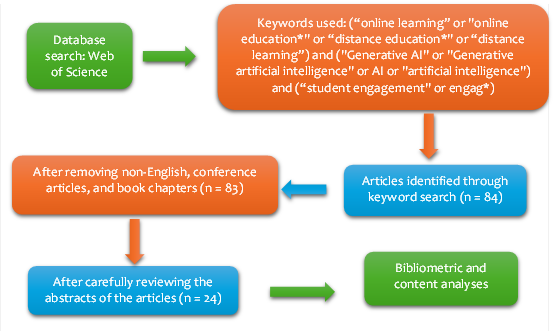
were excluded, which resulted in a total of 83 articles. After carefully
reviewing the abstracts of these 83 articles, 24 were kept for further
bibliometric and content analyses as they are more closely related to the
research focuses of this study. The flowchart of the methodology is presented
in Figure 1.
Figure
1. Flowchart of methodology. Source: Own elaboration.
RESULTS
Bibliometric
analysis
Bibliometric
analysis helps identify the relevant research trends in terms of year-wise
publications and citations (Galetsi & Katsaliaki,
2020). Though
only 24 articles were identified as closely related to the research focus of
this study, the citation report from WoS was used for a brief bibliometric
analysis. Figures 2 and 3 show that research in the field has just gained
attention in 2021, and there is an increasing trend in publications and
citations in the following years. As this review study is being carried out in
2024, only two publications are available. It is expected that the topic of
implementing AI to promote student engagement in online learning will draw more
attention and be further explored in the near future.
Figure 2. Year-wise publication trends. Source:
Own elaboration.
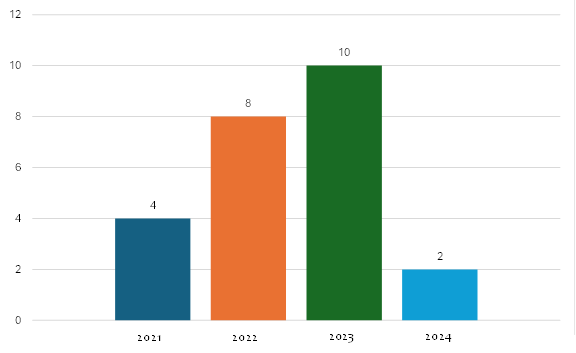
Figure 3. 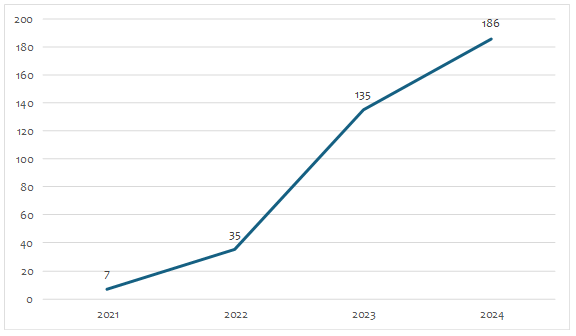
Year-wise
citation trends. Source: Own elaboration
Content analysis
RQ1:
How was AI implemented to promote student engagement in online learning?
The
implementation of AI to promote student engagement in online learning can be
classified into six key areas: 1) integrating chatbots as a tool in course
design, 2) using AI for emotion/facial/voice recognition or eye tracking, 3)
applying machine learning techniques to analyze various data sources, 4)
facilitating teacher-student interaction through AI, 5) providing feedback and
recommendations with AI, and 6) developing AI-powered bots to support online
learning and modern education. These approaches are summarized in Table 1.
1. Integrate
Chatbots as a tool in course design. AI-powered chatbots have been
effectively used to enhance student engagement in online learning. For
instance, studies by Karatas et al. (2024) and Sadegh-Zadeh et al. (2023) integrated chatbots into
language and programming courses for interactive support and content guidance. Ilieva et al. (2023) proposed a five-stage
framework for chatbot use, with the most significant impact occurring before
and after class. Hsiao and Chang (2023) developed AI tools for
autonomous English learning, offering grammar correction, text summarization,
and keyword search functionalities. These studies demonstrate the growing
potential of chatbots to enhance learner autonomy, motivation, and interaction
in online learning environments.
2. Use AI
for emotion/facial/voice recognition or eye tracking. AI technologies such as
emotion recognition, facial analysis, and eye tracking are increasingly used to
assess student engagement. For instance, Dimitriadou and Lanitis
(2024) and Harb et al. (2023) employed computer vision
and deep neural networks to recognize student actions and emotional states. Awais et al. (2021) used IoT-based
physiological sensors with LSTM models to detect emotional responses. Hasnine et al. (2023) introduced a facial
expression and eye-movement framework for real-time engagement analytics. Xu et al. (2023) combined facial and voice
recognition with survey data to identify engagement predictors, while Wang et al. (2021) reviewed eye-tracking
tools for monitoring cognitive engagement. In addition, Sasaki et al. (2023) analyzed student video
reports to estimate engagement levels. These studies illustrate the use of
multimodal AI systems to detect and measure student engagement.
3. Use
machine learning techniques to analyze various sources of data. Machine learning techniques
are widely applied to analyze data and enhance student engagement. For
instance, Raj and Renumol (2022) developed predictive
models using student activity data to classify engagement levels. Huang et al. (2023) combined structural
equation modeling and neural networks to predict emotional engagement,
achieving high accuracy. Lee et al. (2022) used BERT-based models to
classify cognitive presence from forum texts, correlating it with engagement. Ou et al. (2023) applied dynamic graph
neural networks to analyze educational videos and predict student engagement.
These studies highlight machine learning's potential to personalize learning
experiences and foster proactive engagement strategies.
4. Use AI to
facilitate teacher-student interaction. AI is also increasingly employed to
enhance teacher-student interaction and personalize feedback. For instance, Xie et al. (2023) introduced a real-time AI
analysis system that monitored and improved teacher-student interaction through
classroom behavior analysis (Lluberes & Barroso-Osuna, 2024). Similarly, Seo et al. (2021) reviewed various AI tools
categorized by communication, support, and presence, highlighting their
potential to enrich interaction while also raising concerns around ethics and
agency. These findings suggest that AI can play a critical role in enriching instructional
interactions and fostering more responsive and engaging learning environments.
5. Use AI to
provide feedback and recommendations. In terms of feedback and
recommendations, AI-driven systems have also demonstrated significant impact.
For instance, Lv (2023) utilized a deep
learning-based flipped classroom model in music education to deliver adaptive
feedback. Hooda et al. (2022) compared several machine
learning techniques for intelligent feedback and found that Fully Connected
Networks (I-FCN) yielded the best results. Li and Peng (2022) built an AI system for
online English learning that provided real-time diagnostics and personalized
recommendations based on learners’ mastery levels. Huang et al. (2023) developed a recommendation
system using machine learning to suggest videos based on student performance,
which is effective, particularly for moderately motivated students. Bañeres et al. (2023) proposed a Learning
Intelligent System (LIS) that used predictive modeling to monitor student
progress and recommend optimal learning intervals to prevent dropout and
improve outcomes. These studies underscore the effectiveness of AI-powered
feedback systems in adapting to learners’ needs and encouraging self-directed
improvement.
6. Develop
AI-powered bots to support online
learning and modern education. AI-powered bots are increasingly used to boost student
engagement in online learning. For instance, Saleeb (2021) integrated bots like
Pandorabots and Pikkubots into interactive class projects, which helped
students stay engaged and meet learning goals. Similarly, Nguyen et al. (2022) introduced virtual
assistants, telepresence, guide, and delivery robots on a smart campus. Their
virtual assistant, built using natural language processing and machine
learning, created a more interactive and engaging learning environment. These
implementations highlight the expanding role of AI bots in creating dynamic,
supportive, and student-centered educational experiences.
RQ2:
What types of data resources can be used when researching the implementation of
AI in online learning?
Understanding
the types of data used in previous studies can guide effective data collection
and help researchers choose the most suitable AI techniques. The reviewed
literature categorized data sources into four main types: 1) video recordings
of online learners, 2) online learning activity data, 3) existing datasets, and
4) survey data collected for targeted variables (Table 2).
Video
recordings of online learners were the most frequently used data type.
Researchers applied machine learning techniques, such as facial, emotion, voice
recognition, and eye-tracking, to analyze these recordings. These models helped
classify learners into different engagement categories and predict their
engagement levels (Awais et al., 2021;
Dimitriadou & Lanitis, 2024; Harb et al., 2023; Hasnine et al., 2023;
Sasaki et al., 2023; Wang et al., 2021; Xu et al., 2023).
Online learning
activity data, extracted from learning management systems, includes data from
the homepage, subpage, content, URL, and discussion forum (Lee et al., 2022), learners’ profile
information, test results, performance data, and daily clickstream data (Bañeres et al., 2023;
Huang et al., 2023; Li & Peng, 2022), and video reviewing data such as
video-viewing lists and video-viewing time (Huang et al., 2023). It also encompasses
instructional interaction data like speech ratios and response rates (Xie et al., 2023) and performance logs, such
as exercises performed by teachers and students (Lv, 2023).
In addition,
existing datasets such as the Open University Learning Analytics Dataset
(OULAD) (Hooda et al., 2022; Raj
& Renumol, 2022)
and YouTube dataset (Ou et al., 2023) provide valuable secondary
data sources. Some studies also employed survey data to capture specific
research variables (Huang et al., 2023; Seo et
al., 2021).
Table
2. Types of data resources. Source: Own elaboration.
|
Types
of data resources
|
Reference
|
|
1.
Online learners’ video recordings
|
(Awais
et al., 2021)
|
|
(Dimitriadou
& Lanitis, 2024)
|
|
(Harb et
al., 2023)
|
|
(Hasnine
et al., 2023)
|
|
(Sasaki
et al., 2023)
|
|
(Wang et
al., 2021)
|
|
(Xu et
al., 2023)
|
|
2.
Online learning activity data
|
(Lee et
al., 2022)
|
|
(Bañeres
et al., 2023)
|
|
(Huang
et al., 2023)
|
|
(Li
& Peng, 2022)
|
|
(Xie et
al., 2023)
|
|
(Lv,
2023)
|
|
3.
Existing datasets
|
(Raj
& Renumol, 2022)
|
|
(Hooda
et al., 2022)
|
|
(Ou et
al., 2023)
|
|
4.
Survey data collected for the variables of interest
|
(Huang
et al., 2023)
|
|
(Seo et
al., 2021)
|
|
5.
No data resources were used when implementing AI
|
(Karatas
et al., 2024)
|
|
(Sadegh-Zadeh
et al., 2023)
|
|
(Hsiao
& Chang, 2023)
|
|
(Saleeb,
2021)
|
|
(Nguyen
et al., 2022)
|
|
(Ilieva
et al., 2023)
|
RQ3: How was
student engagement measured when implementing AI in online learning?
In addition to
exploring various data sources, it is also essential to understand how student
engagement has been measured in AI-driven research. Based on the reviewed
literature, engagement measurement methods were grouped into three main
categories: 1) survey-based measurements, 2) AI-based recognition, and 3) data
coding using AI or machine learning techniques. These are summarized in Table
3.
Survey-based
approaches included both quantitative scales (Sadegh-Zadeh et al., 2023) and qualitative interviews
(Karatas et al., 2024) to assess student
engagement. AI-based recognition methods focused on interpreting facial
expressions, emotions, and vocal cues. For example, Dimitriadou and Lanitis
(2024) used
facial recognition to categorize engagement into physical presence, active
participation, and distraction. Harb et al. (2023) applied emotion
recognition to identify seven engagement states: bored, distracted, confused,
enjoying, interested, neutral, and worried. Similarly, Sasaki et al. (2023) analyzed voice patterns,
such as negative phrases, filled pauses, and silent gaps, to determine
engagement levels.
The third
category involved coding engagement-related behaviors using AI or machine
learning models. This included analyzing teacher-student interactions (Xie et al., 2023), learning activities (Saleeb, 2021), video engagement (Ou et al., 2023), and discussion forum
participation (Lee et al., 2022). Notably, four out of the
24 reviewed articles did not directly measure engagement but instead emphasized
AI’s potential to support and enhance engagement in online learning
environments.
Table
3. Measure of student engagement. Source: Own elaboration.
|
How
was student engagement measured?
|
Reference
|
Measure of student engagement
|
|
1.
Survey-based measurements
|
(Sadegh-Zadeh
et al., 2023)
|
Survey questions (students’ perceptions of
their engagement in online courses).
|
|
(Hsiao
& Chang, 2023)
|
Both survey questions (quantitative
measure) and assignments (qualitative measure) were used to assess student
engagement.
|
|
(Xu et
al., 2023)
|
Survey instrument from Oga-Baldwin
and Nakata (2017).
|
|
(Huang
et al., 2023)
|
Survey questions were used to assess
emotional engagement.
|
|
(Lv,
2023)
|
Ten survey questions were developed to
determine student engagement in music education.
|
|
(Li
& Peng, 2022)
|
Two survey questions were developed to
investigate how students perceive their engagement in the AI-based flipped
class.
|
|
(Karatas
et al., 2024)
|
Semi-structured interview form questions
(qualitative case study).
|
|
(Seo et
al., 2021)
|
Use semi-structured interviews to measure
student engagement through students’ and teachers’ perceptions of the impact
of various AI systems on student-teacher interaction.
|
|
2.
Measuring through AI recognition
|
(Hasnine
et al., 2023)
|
Measure through facial recognition and
eye-tracking and classify engagement into five categories: 1) strong
engagement, 2) high engagement, 3) medium engagement, 4) low engagement, and
5) disengagement.
|
|
(Dimitriadou
& Lanitis, 2024)
|
Facial recognition–based classification of
engagement levels: 1) physical presence, 2) active participation, and 3)
distraction.
|
|
(Harb et
al., 2023)
|
Measure through emotion recognition and
classify engagement into seven categories: 1) bored, 2) distracted, 3)
confused, 4) enjoying, 5) interested, 6) neutral, and 7) worried.
|
|
(Awais
et al., 2021)
|
Measure through emotion recognition and
classify engagement into four categories: 1) amusing, 2) boring, 3)
relaxation, and 4) scary.
|
|
(Sasaki
et al., 2023)
|
Measure through voice recognition and
identify the level of engagement based on the number of negative phrases,
filled pauses, and silent pauses. Survey questions (UWES-3 questionnaire)
developed by Schaufeli
et al. (2019).
|
|
3.
Measuring by coding various types of data
|
(Huang
et al., 2023)
|
Measure student engagement through eleven
indicated suggested in the learning management system (LMS), including 1)
days watched, 2) watching sessions, 3) total watching time, 4) videos
watched, 5) previewed videos watched, 6) on-track videos watched, 7)
rewatched videos, 8) videos not watched, 9) makeup videos, 10) forum post
days, and 11) forum post times.
|
|
(Raj
& Renumol, 2022)
|
Measure based on three features: 1)
learners’ total number of times accessed the virtual learning environment, 2)
learner’s assessment scores, and 3) learners’ withdrawal status.
|
|
(Lee et
al., 2022)
|
Measure through the coding of data from
discussion forum posts to classify cognitive engagement into five levels: 1)
non-cognitive presence, 2) triggering event, 3) exploration of ideas, 4)
integration of ideas, and 5) resolution of problem or issue.
|
|
(Saleeb,
2021)
|
Measure student engagement through two
indicators: 1) number of online sessions attended and 2) number of a
student’s chat interactions in an online session.
|
|
(Xie et
al., 2023)
|
Measure student engagement through the
evaluation of student-teacher interaction. Student-teacher interaction was
assessed by the ratio of student-teacher speaking time in a class, percentage
of teacher talk (TT), percentage of student talk (PT), teacher response rate
(TRR), and student stable state ratio (PSSR).
|
|
(Bañeres
et al., 2023)
|
Measure student engagement based on student
dropout rate. A lower student drop rate indicated a higher level of student
engagement, and vice versa.
|
|
(Ou et
al., 2023)
|
Measure learner engagement through the
evaluation of video engagement time using both YouTube videos’ static and
dynamic information. Normalize engagement time to represent learner
engagement on a given day.
|
|
4.
No measurement for student engagement
|
(Wang et
al., 2021)
|
No measure for student engagement. A
literature review of different types of eye-tracking and learning systems,
software, datasets, and related studies.
|
|
(Hooda
et al., 2022)
|
No measure for student engagement. A
comprehensive review of the impact of assessment and feedback on student
engagement.
|
|
(Nguyen
et al., 2022)
|
No measure for student engagement. The
paper introduced the details of how four AI-powered robot systems were
implemented in a smart university campus, without assessing the effects of
the implementation.
|
|
(Ilieva
et al., 2023)
|
No measure for student engagement. The
researcher assessed students’ attitudes toward AI chatbot adoption through a
survey.
|
DISCUSSION
RQ1 explores
how AI was implemented to promote student engagement in online learning. It is
important because knowing how AI was implemented can help researchers and
practitioners create more engaging online learning experiences that meet the
diverse needs of online students. As Table 1 suggests, the previous studies can
be classified into six categories.
Out of 24
journal articles reviewed, seven studies applied AI for emotion/facial/voice
recognition or eye tracking, four used AI to analyze various types of data, and
the other five implemented AI for generating feedback and recommendations.
These 16 research studies (67%) use machine learning techniques for model
construction when implementing AI. On the other hand, four out of 24 studies
were interested in incorporating Chatbots into the course design, as the
various implementations of the GPT language model have drawn increasing
attention in recent years. Two studies discuss the use of AI-powered bots to
support online learning and modern education, and the other two applied AI to promote
student engagement through teacher-student interaction. As the review suggests,
AI was most widely used for model construction using machine learning
techniques in previous literature.
Regarding RQ2,
the types of data resources used in previous literature were summarized in
Table 2. It is important because pairing various data resources with AI
technologies may result in innovative solutions that help researchers and
practitioners develop more effective AI systems to promote student engagement
in online learning. Results suggest that seven studies (29%) used online
learners’ video recordings, whereas six (26%) used online learners’ activity
data from the learning management systems. Existing datasets, such as OULAD and
YouTube datasets, can also be utilized for research purposes. The remaining six
research studies incorporated Chatbots or AI bots and did not use any data
resources. As the review suggests, the learners’ video recordings or activity
data were the primary data resources used in previous studies, which may
provide important references for future researchers and practitioners.
RQ3 examined
how student engagement was measured in previous studies. This is important
because research on student engagement is usually conducted in the context of
empirical studies. Implementing AI to promote student engagement in online
learning is a novel research field. Understanding how student engagement was
evaluated can provide a valuable reference to the researchers and practitioners
and help them develop effective strategies that can better engage students in
online learning activities. Results suggest that the measurements can be
classified into three categories: 1) survey-based measurements, 2) measuring
student engagement through AI recognition, and 3) measuring student engagement
by coding various types of data.
As Table 3
indicates, eight studies applied survey-based questionnaires to evaluate
student engagement (either quantitative or qualitative), whereas five used
facial/emotion/voice recognition to classify student engagement into different
levels. Seven studies coded various types of data available to assess student
engagement, and the other four did not evaluate student engagement in their
research design. In summary, a quantitative or qualitative survey is still a
preferred instrument used by many researchers when assessing student engagement.
On the other hand, using AI recognition to classify the level of student
engagement or coding various types of online learners’ activity data are the
other options available. It is highly recommended to use AI recognition to
classify and measure student engagement, which may offer a more objective
instrument for evaluating student engagement.
Critical
reflection on findings and scientific relevance
Beyond the
descriptive synthesis of the reviewed studies, the findings of this review
allow for a broader and more critical reflection on the current state of
research on artificial intelligence in online learning environments. One of the
most significant observations is that AI has been applied to detect, measure,
and predict student engagement through machine learning models and multimodal
data analysis. While this trend reflects a high level of technical
sophistication, it also reveals a limited pedagogical orientation, as fewer
studies focus on how AI-driven insights are systematically translated into
instructional interventions that actively enhance learning processes.
From a
scientific perspective, this imbalance suggests that the field has advanced
more rapidly in terms of data processing and engagement analytics than in the
development of pedagogically grounded AI-supported learning designs. The
emphasis on engagement detection highlights the need for future research to
move beyond monitoring and prediction toward the design of adaptive learning
systems that meaningfully integrate AI into instructional decision-making and
creative learning activities.
In terms of
applicability, the findings indicate that many AI-based approaches are
currently more feasible in higher education institutions with access to
advanced technological infrastructures, large datasets, and interdisciplinary
research teams. This raises important questions about scalability and equity,
particularly in educational contexts with limited resources. Consequently, the
transferability of these AI-driven solutions to diverse learning environments
remains a critical challenge that warrants further empirical investigation.
Additionally,
the review underscores several limitations and risks associated with the
implementation of AI in online learning. Ethical concerns related to data
privacy, algorithmic bias, and the potential normalization of continuous
surveillance emerge as persistent issues, especially in studies relying on
facial, emotional, or behavioral recognition technologies. Furthermore, the
lack of consensus regarding the conceptualization and measurement of student
engagement complicates cross-study comparisons and limits the generalizability
of research findings.
Despite these
challenges, this review makes a distinct contribution to scientific literature
by integrating research on artificial intelligence, student engagement, and
creativity within a single analytical framework. By combining bibliometric
analysis with a systematic content review, the study identifies emerging
technological trends and pedagogical gaps, offering a structured foundation for
future research aimed at designing AI-enhanced online learning environments
that are not only engaging but also creativity-oriented and educationally
meaningful.
Practitioners
are encouraged to integrate AI-driven tools such as chatbots and emotion
recognition systems into their course designs. These technologies can make online
learning more engaging by offering personalized support, real-time feedback,
and a sense of connection, helping to reduce feelings of isolation. Secondly, it is suggested
that practitioners utilize diverse data sources to develop more robust AI
models that can accurately assess and promote student engagement. These data
sources may include video recordings, student activity logs, discussion forum
interactions, and real-time performance data. Combining multiple data sources gives
AI models a more complete picture of student engagement and learning behaviors. Additionally,
practitioners may combine both objective and subjective engagement measures to
ensure more accurate and reliable insights into student online learning
experiences. Traditional
surveys provide valuable insights, but AI-based tracking can offer a more
accurate and well-rounded view of how students interact with online learning
materials.
Finally, practitioners are encouraged to use AI-powered feedback and recommendation systems to
provide students with timely, targeted recommendations for improving their
learning outcomes. Tools
like automated alerts, engagement tracking dashboards, and personalized
learning suggestions can help students stay on track, address learning
challenges early, and improve their overall learning experience.
Researchers
should focus on developing standardized AI-driven frameworks for classifying
student engagement in online learning environments. A consistent framework would make it
easier to compare studies and improve the accuracy of AI models across
different educational settings.
Secondly, researchers may explore the potential of machine learning, deep
learning, and natural language processing in creating more adaptive and
intelligent engagement models. AI
should be designed to detect early signs of disengagement and offer real-time support to keep students
on track.
Thirdly, researchers may investigate how AI can be used to provide personalized
learning feedback, automated warning systems, and intervention strategies to
improve student engagement. It
is important to study how effective AI-generated feedback is in improving
learning outcomes.
Additionally, integrating both subjective (surveys and interviews) and
objective (AI-based) measures for student engagement in one study is
recommended for researchers. Comparing
these different approaches could reveal important insights and highlight any
gaps between human-reported engagement and AI analysis. Finally, longitudinal studies that
focus on assessing the AI impact on student engagement over extended periods
may be an attractive avenue for researchers. Understanding how AI adapts to
changing educational needs over time can provide key insights into its role in
shaping the future of online learning.
Impact on
society
The integration
of AI to promote student engagement in online learning has great potential to
impact our society. Firstly, it
can promote educational equity by personalizing learning experiences to meet
the unique needs of each student. This
means that students from different backgrounds and learning abilities can get
the support they need, helping to close knowledge gaps and provide better
opportunities for marginalized communities. Secondly, it may assist in preparing
a future-ready workforce with AI skills that can adapt to the fast-changing and
evolving job market. As
industries increasingly rely on automation and data-driven decision-making,
students who learn in AI-powered environments will develop critical thinking
and problem-solving skills that will set them up for success. Finally, it could drive
the development of innovative teaching methodologies and make quality education
more accessible to a broader population. With tools like virtual and augmented
reality, gamification, and intelligent tutoring systems, AI can help create
interactive lessons that keep students motivated and actively involved in their
education.
Future Research
and Limitations
Based on the
review of the existing literature, there are several avenues for future studies
in implementing AI to promote student engagement in online learning
environments. First, previous literature classified student engagement into
different categories and used various machine learning techniques for model
construction. Future research may standardize the classification of student
engagement and develop a model that is more generalizable and applicable to
different scenarios. As it is the era of big data, more data will be available
to train the models. Implementing machine learning techniques for model
construction to promote student engagement will still be the most preferable
research direction in the field. In addition, integrating Chatbots or AI-powered
bots in online course design is highly recommended, as the rapid evolution of
large language models can provide a strong tool to overcome the challenges of
online learning and support online students to be more self-regulated and
engaged in online learning activities.
Moreover, one
category suggested in Table 1 may require more attention in future research:
using AI to provide feedback and recommendations to improve student engagement.
As the goal of implementing AI in online education is to promote online
students’ engagement and learning experience, more research is needed to
explore how to use AI to facilitate this process through the development of
feedback or warning systems. Finally, it was noticed that the previous
literature measured student engagement using either survey-based questionnaires
(subjective measure) or machine learning techniques to classify the levels of
student engagement (objective measure). Future research may apply both measures
in one study and assess the alignment through the comparison.
Except for the
potential future research stated above, several limitations need to be
addressed. First, only the WoS database was used to identify the relevant
studies. This review did not search the articles from other databases, such as
Scopus and Dimensions. Also, the conference proceedings or book chapters were
not included in this review. A broader search may yield more articles to be
identified. Additionally, the research interests of this study were limited in
the scope of how the implementation of AI promotes student engagement in online
education. A more general research scope, such as a literature review of how AI
is implemented in online education, may offer a bigger picture to the
researchers and practitioners.
CONCLUSION
Engaging
students in online learning environments has always been a challenge as it
requires more self-autonomy and self-regulation for those online students. The
emergence and development of modern AI technologies may offer a potential
solution. In this research, a literature review was carried out to summarize
previous studies on implementing AI to promote student engagement in online
learning. The findings suggest that AI was most widely used for model
construction using machine learning techniques, and learners’ video recordings
or activity data were the primary data resources used in previous literature.
In addition, it is highly recommended to use AI recognition to classify and
measure student engagement objectively. Overall, the research findings may
provide a valuable reference for future researchers and practitioners. By
understanding the three research questions proposed, researchers and
practitioners may be able to design more efficient AI systems, develop more
effective strategies, and create more engaging learning experiences for online
students.
This study
contributes to the growing body of research on education mediated by artificial
intelligence by offering a systematic and integrative overview of how AI has
been used to support student engagement and creativity in online learning
environments. By identifying prevailing technological approaches, data
resources, and engagement measurement strategies, the review provides a
coherent framework that can guide future empirical research and instructional
design. In this sense, the findings highlight the need to move toward
pedagogically grounded and ethically responsible AI-enhanced learning systems
that not only monitor engagement but also actively support creative, inclusive,
and meaningful learning experiences in digital education.
REFERENCES
Alam, A.
(2023). Harnessing the Power of AI to Create Intelligent Tutoring Systems for
Enhanced Classroom Experience and Improved Learning Outcomes. In Intelligent
Communication Technologies and Virtual Mobile Networks (pp. 571-591).
Springer.
Aldoseri, A.,
Al-Khalifa, K. N., & Hamouda, A. M. (2023). Re-Thinking Data
Strategy and Integration for Artificial Intelligence: Concepts, Opportunities,
and Challenges. Applied Sciences-Basel, 13(12), 7082. https://doi.org/10.3390/app13127082
Awais, M.,
Raza, M., Singh, N., Bashir, K., Manzoor, U., Islam, S. U., & Rodrigues, J.
(2021). LSTM-Based Emotion Detection Using Physiological Signals: IoT Framework
for Healthcare and Distance Learning in COVID-19. IEEE Internet Things J,
8(23), 16863-16871. https://doi.org/10.1109/JIOT.2020.3044031
Baig, M.
I., & Yadegaridehkordi, E. (2023). Flipped classroom in higher education: a
systematic literature review and research challenges. International Journal
of Educational Technology in Higher Education, 20(1), 61. https://doi.org/10.1186/s41239-023-00430-5
Bañeres,
D., Rodríguez-González, M. E., Guerrero-Roldán, A.-E., & Cortadas, P.
(2023). An early warning system to identify and intervene online dropout
learners. International Journal of Educational Technology in Higher
Education, 20(1), Article 3. https://doi.org/10.1186/s41239-022-00371-5
Birkle,
C., Pendlebury, D. A., Schnell, J., & Adams, J. (2020). Web of Science as a
data source for research on scientific and scholarly activity. Quantitative
Science Studies, 1(1), 363-376. https://doi.org/10.1162/qss_a_00018
Castro, M.
D. B., & Tumibay, G. M. (2021). A literature review: efficacy of online
learning courses for higher education institution using meta-analysis. Education
and information technologies, 26(2), 1367-1385.
Castro, R.
(2019). Blended learning in higher education: Trends and capabilities. Education
and information technologies, 24(4), 2523-2546.
Chassignol,
M., Khoroshavin, A., Klimova, A., & Bilyatdinova, A. (2018). Artificial
Intelligence trends in education: a narrative overview. Procedia computer
science, 136, 16-24.
Chavarro, D., Ràfols,
I., & Tang, P. (2018). To what extent is inclusion in the Web of
Science an indicator of journal ‘quality’? Research Evaluation, 27(2),
106-118. https://doi.org/10.1093/reseval/rvy001
Crompton,
H., & Burke, D. (2023). Artificial intelligence in higher education: the
state of the field. International Journal of Educational Technology in
Higher Education, 20(1), 22. https://doi.org/10.1186/s41239-023-00392-8
Daniel,
K., Msafiri, M., Xiulan, W., & Fute, A. (2024). Enhancing student
engagement in online education: The role of self-regulation and teacher support
in Zambia.
Dimitriadou,
E., & Lanitis, A. (2024). Student Action Recognition for Improving Teacher
Feedback During Tele-Education. IEEE Transactions on Learning Technologies, 17, 569-584.
https://doi.org/10.1109/Tlt.2023.3301094
Fernández-Batanero,
J. M., Román-Graván, P., Montenegro-Rueda, M., & Fernández-Cerero, J.
(2021). El impacto de las TIC en el alumnado con discapacidad en la Educación
Superior. Una
revisión sistemática (2010-2020). Edmetic, 10(2), 81-105 https://doi.org/10.21071/edmetic.v10i2.13362
Fredricks,
J. A. (2022). The measurement of student engagement: Methodological advances
and comparison of new self-report instruments. In Handbook of research on
student engagement (pp. 597-616). Springer.
Fredricks,
J. A., & McColskey, W. (2012). The Measurement of Student Engagement: A
Comparative Analysis of Various Methods and Student Self-report Instruments. In
S. L. Christenson, A. L. Reschly, & C. Wylie (Eds.), Handbook of
Research on Student Engagement (pp. 763-782). Springer US. https://doi.org/10.1007/978-1-4614-2018-7_37
Galetsi,
P., & Katsaliaki, K. (2020). Big data analytics in health: an overview and
bibliometric study of research activity. Health Info Libr J, 37(1),
5-25. https://doi.org/10.1111/hir.12286
Gligorea,
I., Cioca, M., Oancea, R., Gorski, A. T., Gorski, H., & Tudorache, P.
(2023). Adaptive Learning Using Artificial Intelligence in e-Learning: A
Literature Review. Education Sciences, 13(12), 1216. https://doi.org/10.3390/educsci13121216
Harb, A.,
Gad, A., Yaghi, M., Alhalabi, M., Zia, H., Yousaf, J., Khelifi, A., Ghoudi, K.,
& Ghazal, M. (2023). Diverse distant-students deep emotion recognition and
visualization. Computers & Electrical Engineering, 111,
Article 108963. https://doi.org/10.1016/j.compeleceng.2023.108963
Hasnine, M. N.,
Nguyen, H. T., Tran, T. T. T., Bui, H. T. T., Akcapinar, G., & Ueda, H.
(2023). A
Real-Time Learning Analytics Dashboard for Automatic Detection of Online
Learners' Affective States. Sensors (Basel), 23(9), Article 4243.
https://doi.org/10.3390/s23094243
Hooda, M.,
Rana, C., Dahiya, O., Rizwan, A., & Hossain, M. S. (2022). Artificial
Intelligence for Assessment and Feedback to Enhance Student Success in Higher
Education. Mathematical Problems in Engineering, 2022, Article
5215722. https://doi.org/10.1155/2022/5215722
Hsiao, J.
C., & Chang, J. S. (2023). Enhancing EFL reading and writing through
AI-powered tools: design, implementation, and evaluation of an online course. Interactive
Learning Environments, 1-16. https://doi.org/10.1080/10494820.2023.2207187
Huang, A.
Y. Q., Lu, O. H. T., & Yang, S. J. H. (2023). Effects of artificial
Intelligence–Enabled personalized recommendations on learners’ learning
engagement, motivation, and outcomes in a flipped classroom. Computers &
Education, 194, Article 104684. https://doi.org/10.1016/j.compedu.2022.104684
Huang, C.
Q., Zhang, L. J., He, T., Wu, X. M., Pan, Y. F., Han, Z. M., & Zhao, W. Z.
(2023). The role of emotion regulation in predicting emotional engagement
mediated by meta-emotion in online learning environments: a two-stage SEM-ANN
approach. Educational Psychology, 43(7), 736-755. https://doi.org/10.1080/01443410.2023.2254524
Ilieva,
G., Yankova, T., Klisarova-Belcheva, S., Dimitrov, A., Bratkov, M., &
Angelov, D. (2023). Effects of Generative Chatbots in Higher Education. Information,
14(9), Article 492. https://doi.org/10.3390/info14090492
Karatas,
F., Abedi, F. Y., Gunyel, F. O., Karadeniz, D., & Kuzgun, Y. (2024).
Incorporating AI in foreign language education: An investigation into ChatGPT's
effect on foreign language learners. Education and information technologies.
https://doi.org/10.1007/s10639-024-12574-6
Lee, J.,
Soleimani, F., Irish, I., Hosmer, J., Soylu, M. Y., Finkelberg, R., &
Chatterjee, S. (2022). Predicting Cognitive Presence in At-Scale Online
Learning: MOOC and For-Credit Online Course Environments. Online Learning,
26(1), 58-79. https://doi.org/10.24059/olj.v26i1.3060
Li, B.,
& Peng, M. M. (2022). Integration of an AI-Based Platform and Flipped
Classroom Instructional Model. Scientific Programming, 2022,
Article 2536382. https://doi.org/10.1155/2022/2536382
Lluberes, P. M.,
& Barroso-Osuna, J. (2024). Un modelo de alfabetización mediática e
informacional para profesores dominicanos del Nivel Secundario. Edmetic,
13(1),
6-6.
https://doi.org/10.21071/edmetic.v13i1.16647
Lv, H. Z.
(2023). Innovative music education: Using an AI-based flipped classroom. Education
and information technologies, 28(11), 15301-15316. https://doi.org/10.1007/s10639-023-11835-0
Nguyen, T.
H., Tran, D. N., Vo, D. L., Mai, V. H., & Dao, X. Q. (2022). AI-Powered
University: Design and Deployment of Robot Assistant for Smart Universities. Journal
of Advances in Information Technology, 13(1), 78-84. https://doi.org/10.12720/jait.13.1.78-84
Oga-Baldwin,
W. L. Q., & Nakata, Y. (2017). Engagement, gender, and motivation: A
predictive model for Japanese young language learners. SYSTEM, 65,
151-163. https://doi.org/10.1016/j.system.2017.01.011
Ou, X. C., Chen, Y.
T., Zhou, S. W., & Shi, J. D. (2023). Online educational
video engagement prediction based on dynamic graph neural networks. International
Journal of Web Information Systems, 19(5-6), 190-207. https://doi.org/10.1108/Ijwis-05-2023-0083
Ouyang,
F., Wu, M., Zheng, L., Zhang, L., & Jiao, P. (2023). Integration of
artificial intelligence performance prediction and learning analytics to
improve student learning in online engineering course. Int J Educ Technol
High Educ, 20(1), 4. https://doi.org/10.1186/s41239-022-00372-4
Raj, N.
S., & Renumol, V. G. (2022). Early prediction of student engagement in
virtual learning environments using machine learning techniques. E-Learning
and Digital Media, 19(6), 537-554. https://doi.org/10.1177/20427530221108027
Sadegh-Zadeh,
S. A., Movahhedi, T., Hajiyavand, A. M., & Dearn, K. D. (2023). Exploring
undergraduates' perceptions of and engagement in an AI-enhanced online course. Frontiers
in Education, 8, Article 1252543. https://doi.org/10.3389/feduc.2023.1252543
Saleeb, N.
(2021). Closing the chasm between virtual and physical delivery for innovative
learning spaces using learning analytics. International Journal of
Information and Learning Technology, 38(2), 209-229. https://doi.org/10.1108/Ijilt-05-2020-0086
Sasaki,
K., He, Z., & Inoue, T. (2023). Using Video Activity Reports to Support
Remote Project-Based Learning. Journal of Universal Computer Science,
29(11), 1336-1360. https://doi.org/10.3897/jucs.113266
Schaufeli,
V. B., Shimazu, A., Hakanen, J., Salanova, M., & De Witte, H. (2019). An
Ultra-Short Measure for Work Engagement The UWES-3 Validation Across Five
Countries. European Journal of Psychological Assessment, 35(4),
577-591. https://doi.org/10.1027/1015-5759/a000430
Seo, K.,
Tang, J., Roll, I., Fels, S., & Yoon, D. (2021). The impact of artificial
intelligence on learner-instructor interaction in online learning. Int J
Educ Technol High Educ, 18(1), 54, Article 54. https://doi.org/10.1186/s41239-021-00292-9
Singh, V.
K., Singh, P., Karmakar, M., Leta, J., & Mayr, P. (2021). The journal
coverage of Web of Science, Scopus and Dimensions: A comparative analysis. Scientometrics,
126(6), 5113-5142. https://doi.org/10.1007/s11192-021-03948-5
Trolian,
T. L. (2023). Student Engagement in Higher Education: Conceptualizations,
Measurement, and Research. In L. W. Perna (Ed.), Higher Education: Handbook
of Theory and Research (pp. 1-60). Springer Nature Switzerland. https://doi.org/10.1007/978-3-031-32186-3_6-1
Wang, Y.
H., Lu, S. L., & Harter, D. (2021). Towards Collaborative and Intelligent
Learning Environments Based on Eye Tracking Data and Learning Analytics: A
Survey. Ieee Access, 9, 137991-138002. https://doi.org/10.1109/Access.2021.3117780
Wong, Z.
Y., & Liem, G. A. D. (2022). Student Engagement: Current State of the
Construct, Conceptual Refinement, and Future Research Directions. Educational
Psychology Review, 34(1), 107-138. https://doi.org/10.1007/s10648-021-09628-3
Xie, Y.,
Huang, Y., Luo, W., Bai, Y., Qiu, Y., & Ouyang, Z. (2023). Design and
effects of the teacher-student interaction model in the online learning spaces.
J Comput High Educ, 35(1), 69-90. https://doi.org/10.1007/s12528-022-09348-9
Xu, X. Q.,
Dugdale, D. M., Wei, X., & Mi, W. J. (2023). Leveraging Artificial
Intelligence to Predict Young Learner Online Learning Engagement. American
Journal of Distance Education, 37(3), 185-198. https://doi.org/10.1080/08923647.2022.2044663
Zhu, J.
W., & Liu, W. S. (2020). A tale of two databases: the use of Web of Science
and Scopus in academic papers. Scientometrics, 123(1),
321-335. https://doi.org/10.1007/s11192-020-03387-8
|
Contribución
de los autores
Los autores contribuyeron en la totalidad de la
investigación.
|
|
Financiación
Este
estudio no fue financiado.
|
|
Agradecimientos
No aplica.
|
|
Conflicto
de intereses
Los autores
declaran no tener ningún conflicto de intereses.
|
|
Declaración
de uso de la IA para la redacción del manuscrito
Los
autores declaran no haber empleado la IA para la redacción total o parcial de
este manuscrito
|
Citación:
González-Zamar, M.D, Abad-Segura, E., & Malikova, K. (2026). Artificial
intelligence and online educational creativity: a critical analysis and
emerging perspectives. EDMETIC, Revista de Educación Mediática y TIC, 15(2), art.4. https://doi.org/10.21071/edmetic.v15i2.18495