
Arquitectura, cultura y crisis: formas del habitar periférico en el audiovisual español
Barra lateral del artículo
Contenido principal del artículo
Resumen
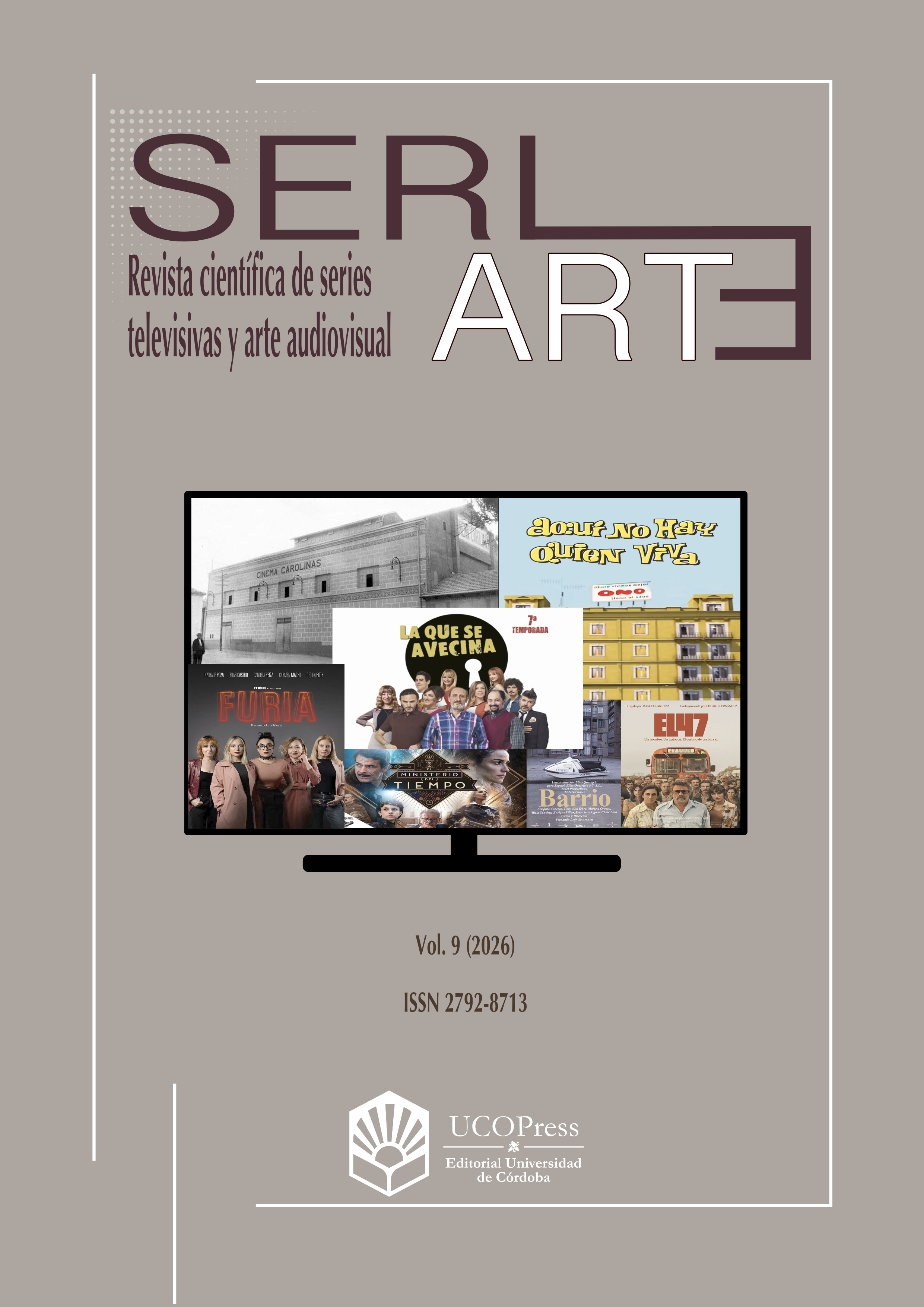
El artículo analiza la representación de las periferias urbanas en la ficción televisiva española contemporánea a través del estudio de las series XHOXB, La que se avecina y Furia, entendiendo la arquitectura y los espacios residenciales como generadores de significado social y narrativo. El objetivo es examinar cómo la televisión configura imaginarios urbanos y traduce las tensiones del habitar moderno mediante la puesta en escena de tipologías residenciales, modos de convivencia y estructuras espaciales. La metodología combina el análisis textual, visual y espacial de las tres producciones, considerando la articulación entre narrativa, estética y contexto social. Los resultados muestran que la arquitectura televisiva funciona como mediador simbólico entre lo urbano y lo social, expresando discursos sobre clase, movilidad y exclusión. Los espacios comunes, como portales o urbanizaciones cerradas, se revelan como ejes que reflejan la transformación de la sociabilidad y la fragmentación del espacio colectivo. El estudio concluye que la ficción televisiva no se limita a reproducir la ciudad urbana y periférica, sino que la interpreta críticamente, ofreciendo una lectura simbólica de las transformaciones urbanas y contribuyendo a la construcción de una memoria colectiva del espacio habitado y de los imaginarios contemporáneos sobre la vida en la periferia.
Descargas
Datos de publicación
Perfil evaluadores/as N/D
Declaraciones de autoría
Indexado en
- Editor y equipo editorial
- Perfiles
- Sociedad académica
- Seriarte. Revista científica de series televisivas y arte audiovisual
- Editorial
- Ucopress. Cordoba University Press

Para obtener más información sobre un dato, haga clic 
PF es mantenido por el Public Knowledge Project
Detalles del artículo

Esta obra está bajo una licencia internacional Creative Commons Atribución-NoComercial-SinDerivadas 4.0.




Citas
AERTSEN, Víctor, GÁMIR ORUETA, Agustín y MANUEL, Carlos (2022) «Ciudad y ficción audiovisual: enfoques para un análisis geográfico», BAGE: Boletín de la Asociación de Geógrafos Españoles, 95, pp. 1-49. https://doi.org/10.21138/bage.3328
AGENCIA TRIBUTARIA. Posicionamiento de los municipios mayores de 1.000 habitantes por Renta bruta media. Situación 2023. 22 de 10 de 2025. https://sede.agenciatributaria.gob.es/AEAT/Contenidos_Comunes/La_Agencia_Tributaria/Estadisticas/Publicaciones/sites/irpfmunicipios/2023/jrubikf6b1df8fe9d9e1b349886f03cf541e3fd2e65dd05.html
AGUILAR LUCATO, Ramón (2020), «La producción desigual de la morfología urbana madrileña», Territorios En formación 17, pp. 60-75. https://doi.org/10.20868/tf.2020.17.4487
ÁLVAREZ MÉNDEZ, Natalia (2010), «Territorios, parajes y contornos literarios. Aproximación teórica al espacio en la narrativa actual», en CELMA VALERO, María Pilar y GONZÁLEZ, José Ramón, Lugares de ficción: la construcción del espacio en la narrativa actual, Valladolid: Universidad de Valladolid, Cátedra Miguel Delibes, pp. 17-38.
ARANGO PINTO, Luis Gabriel (2023), «Memes de Internet, polifonía y análisis transtextual: una propuesta orientada al discurso posvisual desde la complejidad», Designis 41, pp. 47-63. https://doi.org/10.35659/designis.i41p47-63
ARBACI, Sonia (2019), Paradoxes of segregation: housing systems, welfare regimes and ethnic residential change in southern European cities, Nueva Jersey: Wiley-Blackwell.
ARIZA, José, BARAÑANO, Margarita y SORANDO, Daniel (2024), «La precarización de la periferia. Movilidad y desigualdad residencial en Madrid (2013-2019)», Revista EURE - Revista De Estudios Urbano Regionales, 50 (1), pp. 1-23. https://doi.org/10.7764/EURE.50.151.11
BENITO MORENO, Manuel, GONZÁLEZ LÓPEZ, Javier y POZUETA ECHAVARRI, Julio (2018), «La metrópolis tras la burbuja inmobiliaria. Transformación del suelo y formas de crecimiento urbano en Madrid», en DÍEZ MEDINA, Carmen y MONCLÚS, Javier. Ciudad y formar urbanas. Perspectivas transversales. Zaragoza: Prensas de la Universidad de Zaragoza, pp. 135-146.
BERTON, Mireille y BONI, Marta (2019), «How to study the complexity of television series? Towards a spatial approach» TV/Series, 15, pp. 1-18. https://doi.org/10.4000/tvseries.4991
BRUNO, Giuliana (2018), Atlas of emotion: Journeys in Art, Architecture, and Film, Chicago: Verso Books.
CAPPELLO, Giancarlo (2017), Ficciones cercanas. Televisión, narración y espíritu de los tiempos, Lima: Universidad de Lima, Fondo Editorial. https://doi.org/10.18800/conexion.202202.005
CAPPELLO, Giancarlo (2023), «Modulaciones de la ciudad en la ficción televisiva contemporánea» Conexión, 18, pp.127-147.
CARBAJAL BALLELL, Rodrigo (2016), Espacios domésticos de gran escala. La vivienda máxima: estudio de tipologías residenciales de gran superficie en el eje Plaza de Cuba - Avenida de la República Argentina: Sevilla: 1954-196, Sevilla: Universidad de Sevilla.
CORNISH, Flora, GILLESPIE, Alex y ZITTOUN, Tania (2014), «Collaborative Analysis of Qualitative Data», en FLICK, Uwe. The SAGE Handbook of Qualitative Data Analysis. Los Ángeles: SAGE, pp. 79-93.
CUARTERO MIRANDA, Sergio (2020) «Los suburbios en la historia urbana en España», Cuadernos de Historia Contemporánea, 42, pp. 355-364. https://doi.org/10.5209/chco.71913
CUEVAS, Efrén (2007), «Del espacio periurbano al rural: cuatro miradas desde el documental español reciente», Cahiers d’études romanes, 16, pp.165-174. https://doi.org/10.4000/etudesromanes.2272
DELGADO RUIZ, Manuel (2010), «La ciudad levantada: la barricada y otras transformaciones radicales del espacio urbano», Arquitectonics: Mind, Land & Society, 19-20, pp.137-153.
ESCUTIA, Nacho (2025), «Habitar el sentido», en MALDONADO, Rebeca, Dimensiones del habitar, Sevilla: Universidad Nacional Autónoma de México, Facultad de Filosofía y Letras, pp. 179-210.
FIGUEROA, Andrea, SOPRANO, Roxana, AMADO, Marianela, CHARO, Alan, FUERTES, Manuela, LENZ, Nicolás, y STRANO, Leandro (2021), «Sentido y posibilidad. Criterios hacia la selección de informantes claves, sobre la relación entre la modelización del espacio y su aprendizaje en la FAUD, UNMDP» 2021: XXXV Jornadas de Investigación y XVII Encuentro Regional SI+ Palabras clave, pp. 1770-1787. http://www.publicacionescientificas.fadu.uba.ar/index.php/actas/article/view/2086
FURIA (2025), HBO Max.
GHANBARI, Abolfazl y ESHLAGHI, Mehdi (2022), «Geographical Approach to the Promise and Reality of Urban Public Spaces with Emphasis on the Role of Ideologies», The Monthly Scientific Journal of Bagh-e Nazar 19, (11), pp. 5-24. https://doi.org/10.22034/bagh.2022.284275.4878
GÓMEZ DÍAZ DE LEÓN, Carlos y DE LA GARZA, León (2014), Método comparativo. In: Métodos y técnicas cualitativas y cuantitativas aplicables a la investigación en ciencias sociales, México: Tirant Humanidades México.
GONZÁLEZ-GARCÍA, César (2025), «De las periferias a las márgenes urbanas: un giro epistemológico desde territorios de intersección», Revista INVI, 40(115), pp. 1-25. https://doi.org/10.5354/0718-8358.2025.78513
HALL, Peter (1998), Cities in Civilization: Culture, Innovation, and Urban Order, Nueva York: Pantheon Books.
HANSEN, Kim Toft y CHRISTENSEN, Jorgen Rober (2015), «Northern Jutland as an intertextual location: Hyperrealities in peripheral Denmark», en GEBAUER, Mirjam, THORSØE NIELSEN, Helle, TÖDTLOFF SCHLOSSER, Jan y SØRENSEN, Bent. Non-Place: Representing Placelessness in Literature, Media and Culture, Aalborg: Aalborg Universitetsforlag, pp. 259-280.
HARVEY, David (2012), Rebel Cities: From the Right to the City to the Urban Revolution, Nueva York: Verso.
HERNÁNDEZ DELGADILLO, Sergio (2025) «Habitar el desamparo», en MALDONADO, Rebeca. Dimensiones del habitar, México: Universidad Nacional Autónoma de México, Facultad de Filosofía y Letras, pp. 211-234.
IGLESIAS VÁZQUEZ, Manuel (2025), «Between Text and Form: Expanded Textuality in Contemporary Architecture», Humanities 14, p. 163. https://doi.org/10.3390/h14080163
KEIL, Roger (2018) «Extended urbanization, “disjunct fragments” and global suburbanisms», Environment and Planning D: Society and Space 36 (3), pp. 494-511. https://doi.org/10.1177/0263775817749594
LA QUE SE AVECINA (2007- actualidad), Telecinco.
LEFEBVRE, Henri (1991), The Production of Space, Nueva Jersey: Blackwell.
LÓPEZ DE LUCIO, Ramón (2011), «Morfología y características de las nuevas periferias. Nueve paisajes residenciales en la región urbana de Madrid», Urban 9, pp. 56-80.
LUQUE GARCÍA, Eva y FERNÁNDEZ-VALDERRAMA, Luz (2025), «Pedagogías híbridas para arquitecturas ex-nihilo», Astrágalo: Cultura de la Arquitectura y de la Ciudad, 39, pp. 147-166. https://dx.doi.org/10.12795/astragalo.2025.i39.09
MARCUSE, Peter y VAN KEMPEN, Ronald (2020), Globalizing cities: A new spatial order? Nueva Jersey: Blackwell.
MARTÍNEZ PUCHE, Salvador y CASTRO, Deborah (2022), «El espacio urbano y su influencia narrativa en el cine de ficción: una propuesta metodológica aplicada», Boletín De La Asociación De Geógrafos Españoles, 95, pp. 1-34. https://doi.org/10.21138/bage.3301
MCCARTHY, Anna (2001), Ambient Television: Visual Culture and Public Space, Durham: Duke University Press. https://doi.org/10.1215/9780822383130
MÉNDIZ NOGUERO, Alfonso (2018), «City placement. Concepto, literatura científica y método de análisis», en CAMARERO, Emma y MUT CAMACHO Magdalena. Nuevos tratamientos informativos y persuasivos, Madrid: Tecnos, pp. 221-232.
MÜLLER, Jan-Werner (2023), «Just how is architecture ideological? » Journal of Political Ideologies, 28 (3), pp. 412-420. https://doi.org/10.1080/13569317.2023.2243746
PALLASMAA, Juhani (2008), The eyes of the skin, Nueva Jersey: Wiley-Academy.
PALOMARES-SÁNCHEZ, Patricia (2025), «La ficción televisiva española del siglo XXI: tendencias y perspectivas futuras [Reseña]», Revista Mediterránea De Comunicación, 16 (1), pp. 1-3. https://doi.org/10.14198/MEDCOM.27813
RINCÓN DE LA VEGA, Daniel (2010), Una inflexión en la arquitectura de posguerra. Madrid 1955-1970. Vivienda colectiva de lujo, Madrid: Escuela Técnica Superior de Arquitectura.
RODRÍGUEZ SUÁREZ, Iván, VIEDMA GUIARD, Andrés y HERNÁNDEZ AJA, Agustín (2025), «Renta y calidad de la vivienda: un análisis de la fragmentación urbana», Ciudades, 28, pp. 23-46. https://doi.org/10.24197/ciudades.28.2025.23-46
ROSE, Gillian (2016), Visual Methodologies: An Introduction to Researching with Visual Materials, Los Ángeles: SAGE.
RUEDA LAFFOND, José Carlos (2011), «Esta tierra es mía. Espacios históricos y geografía de la memoria en la ficción televisiva española», Historia Actual Online, 269, pp. 27-39. https://doi.org/10.36132/hao.v0i26.554
TORRADO, José Manuel, DUQUE-CALVACHE, Ricardo y NOGUERAS ZONDAG, Roberto (2021), «¿Hacia una ciudad dual? Suburbanización y centralización en las principales ciudades españolas», Revista Española De Investigaciones Sociológicas, 176, pp. 35-58. https://doi.org/10.5477/cis/reis.176.35
TRACY, Sarah J. (2010), «Qualitative Quality: Eight ''Big-Tent'' Criteria for Excellent Qualitative Research», Qualitative Inquiry, 16 (10), pp. 837-85. https://doi.org/10.1177/1077800410383121
VALLEBUONA, G. (2014), Fotografiar e iluminar para televisión, Buenos Aires: Teseo.
XHOXB (2020-2023), Sky Showtime.