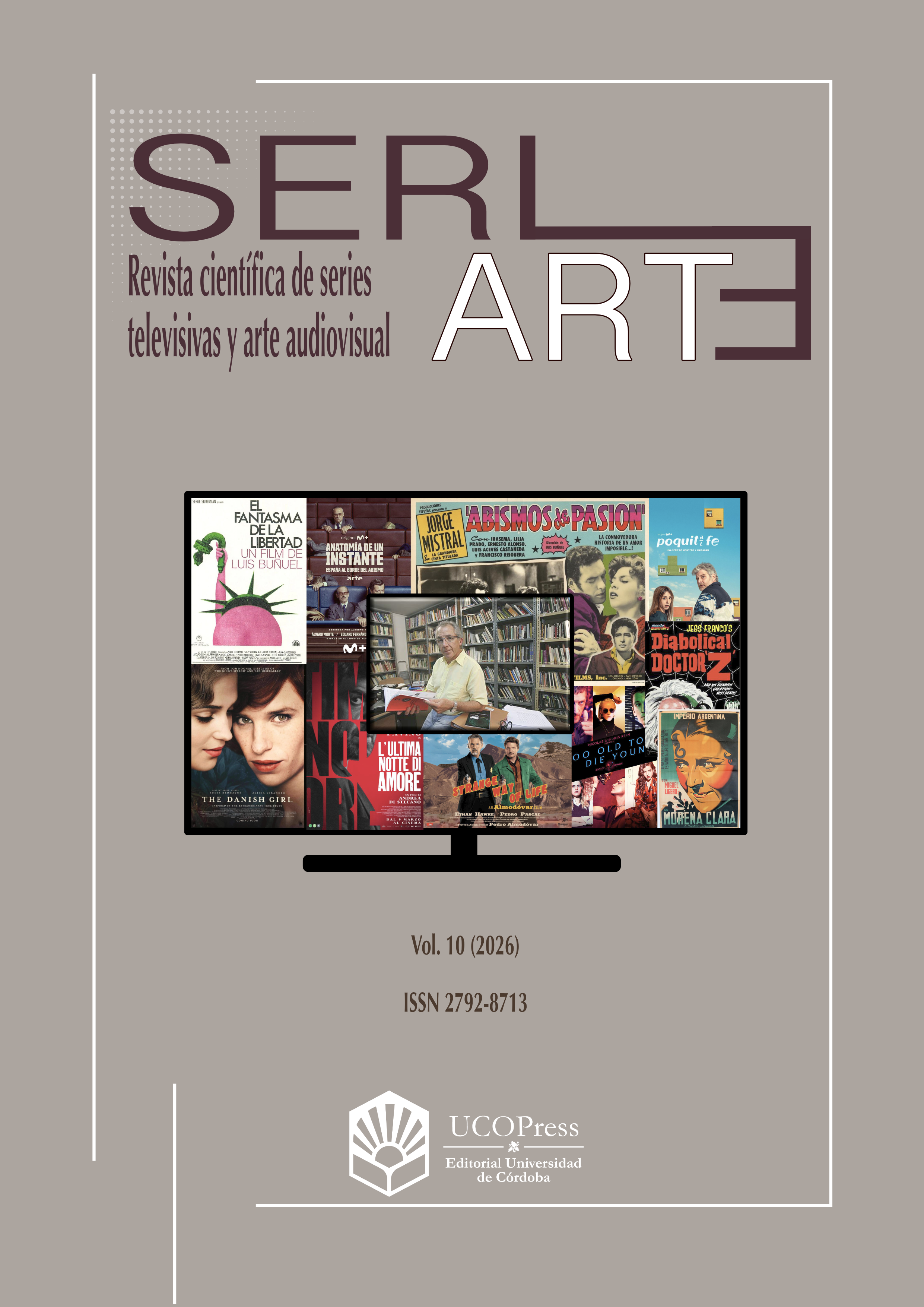
Más filiaciones entre Luis Buñuel y René Magritte: discurso-collage, relato estallado, umbral y momento de pánico en "El fantasma de la libertad" (Luis Buñuel, 1974)
Barra lateral del artículo
Contenido principal del artículo
Resumen
Este artículo examina El fantasma de la libertad (1974), dirigida por Luis Buñuel y perteneciente a la que se ha venido a llamar «última etapa francesa» del artista aragonés, como una reactivación del surrealismo originario del director. Frente a la reducción tradicional del cine buñueliano a lo meramente onírico, se sostiene que el filme despliega una estructura basada en el azar simulado —o en una escritura controlada y consciente que toma como modelo el acontecer azaroso—, el encadenamiento por umbrales, la fragmentación narrativa en línea con el «relato estallado» y la filiación con la pintura de René Magritte, estas dos últimas ya descritas por Pedro Poyato Sánchez en investigaciones anteriores. La disociación, la hibridación entre objetos, la colisión entre realidades convencionalmente irreconciliables y los «momentos de pánico» revelan una lógica común: convertir la imagen en operador de pensamiento, o una muestra plástica del «ver-pensar», y hacer del misterio una experiencia estética.
Descargas
Datos de publicación
Perfil evaluadores/as N/D
Declaraciones de autoría
Indexado en
- Editor y equipo editorial
- Perfiles
- Sociedad académica
- Seriarte. Revista científica de series televisivas y arte audiovisual
- Editorial
- Ucopress. Cordoba University Press

Para obtener más información sobre un dato, haga clic 
PF es mantenido por el Public Knowledge Project
Detalles del artículo

Esta obra está bajo una licencia internacional Creative Commons Atribución-NoComercial-SinDerivadas 4.0.




Citas
BAXTER, John (1996), Luis Buñuel, Barcelona: Paidós.
BRETON, André (2001), Manifiestos del surrealismo, Buenos Aires: Editorial Argonauta.
BUÑUEL, Luis (2022), Le chien andalou et autres textes poétiques, Teruel/París: Poésie/Gallimard.
BUÑUEL, Luis (2024), Mi último suspiro, Barcelona: Debolsillo.
BURCH, Noël (1985), Praxis del cine, Madrid: Fundamentos.
KINDER, Marsha (1975), «The Tyranny of Convention in The Phantom of Liberty», Film Quarterly, vol. 28, n.º 4, pp. 20-25. https://doi.org/10.2307/1211644
LE GALL, Guillaume (2010), «Ver es un acto», en La subversión de las imágenes. Surrealismo. Fotografía, Cine, Madrid: Fundación Mapfre, pp. 214-221.
LYON, Elisabeth H. (1973), «Luis Buñuel: The Process of Dissociation in Three Films», Cinema Journal, vol. 13, n.º 1, pp. 45-48. https://doi.org/10.2307/1225059
MARCHÁN FIZ, Simón (2002), «Las palabras, las imágenes y las cosas», en El surrealismo y sus imágenes, Madrid: Fundación Mapfre Vida, pp. 281-309.
PAQUET, Marcel (2007), Magritte, Köln: TASCHEN.
PÉREZ TURRENT, Tomás, DE LA COLINA, José y BUÑUEL, Luis (2002), Buñuel por Buñuel, Madrid: Plot Ediciones.
POYATO SÁNCHEZ, Pedro (1999), «Un caso paradigmático. Luis Buñuel. Análisis del film “Un perro andaluz”», Trama y Fondo: Revista de Cultura, n.º 7, pp. 77-93.
POYATO SÁNCHEZ, Pedro (2008), «Los procedimientos de formalización de Un perro andaluz (Luis Buñuel, 1929) y su reformulación en la pintura de Magritte», en Modelos, intercambios y recepción artística (de las rutas marítimas a la navegación en red), vol. 1, XV Congreso Nacional de Historia del Arte, pp. 967-976.
POYATO SÁNCHEZ, Pedro (2011), El sistema estético de Luis Buñuel, Zarautz: Servicio Editorial de la Universidad del País Vasco.
SÁNCHEZ VIDAL, Agustín (1994), Luis Buñuel, Madrid: Cátedra.
SÁNCHEZ VIDAL, Agustín (2002), «El surrealismo en el cine», en El surrealismo y sus imágenes, Madrid: Fundación Cultural Mapfre Vida, pp. 211-232.
SÁNCHEZ VIDAL, Agustín (s. f.), «Cine surrealista español: la búsqueda de una concreción», Litoral, n.º 174/176, Surrealismo: el ojo soluble, pp. 89-99.
SOLANA, Guillermo (2002), «El surrealismo y sus imágenes», en El surrealismo y sus imágenes, Madrid: Fundación Cultural Mapfre Vida, pp. 9-28.
SULEIMAN, Susan (1978), «Freedom and Necessity: Narrative Structure in The Phantom of Liberty», Quarterly Review of Film Studies, vol. 3, n.º 3, pp. 277-295. https://doi.org/10.1080/10509207809391406
TALENS, Jenaro (1986), El ojo tachado, Madrid: Cátedra.
TOBIAS, James (1998-1999), «Buñuel’s Net Work: Performative Doubles in the Impossible Narrative of “The Phantom of Liberty”», Film Quarterly, vol. 52, n.º 2, pp. 10-22. https://doi.org/10.2307/1213269
ZUNZUNEGUI, Santos (1994), Paisajes de la forma, Madrid: Cátedra.